Tin atom → Benzene, ethenyl-, polymer with 1,3-butadiene
Reaktionsgleichung

[Sn].[C:2]([C:6]1[CH2:11][C:10](C(C)(C)C)(C)[CH:9]=[CH:8][C:7]=1O)(C)(C)[CH3:3]>CO>[CH2:3]=[CH:2][CH:6]=[CH2:7].[CH2:3]=[CH:2][C:6]1[CH:11]=[CH:10][CH:9]=[CH:8][CH:7]=1Komponenten
Edukt 2


Produkt 1
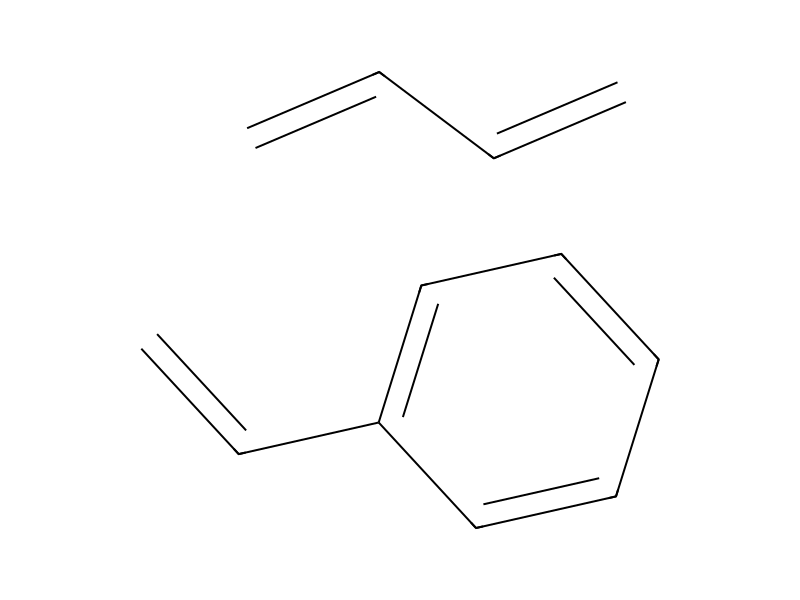
Reagenzien, Katalysatoren, Lösungsmittel 1

Versuchsvorschrift
A 5-liter stainless steel autoclave is purged with nitrogen and then is charged with a mixture of 70 g of styrene, 2053 g of cyclohexane and 210 g of butadiene. Afterwards, the autoclave is heated in a water bath under stirring to reach a temperature of 50° C. and at that temperature, butyllithium is added to remove the impurities reactive to the initiator, followed by 8.4 mmol of the tin-containing organolithium initiator from Example 63. The reaction mixture is allowed to react for 2 hours and then 10 ml of methanol and 1.6 g of 2,4-di-tert.-butyl-4-methylphenol are added. The content of the autoclave is discharged, and coagulated with steam to remove the solvent and the regulator, then dried to a constant weight. GPC measurements show that the polymer obtained has a weight average molecular weight of 120,000, a number average molecular weight of 110,000, and a molecular weight distribution of 1.09.
Aufarbeitung
- customA 5-liter stainless steel autoclave is purged with nitrogen
- additionis charged with a mixture of 70 g of styrene, 2053 g of cyclohexane and 210 g of butadiene
- temperatureAfterwards, the autoclave is heated in a water bath
- customa temperature of 50° C.
- additionat that temperature, butyllithium is added
- customto remove the impurities
- customto react for 2 hours
- customto remove the solvent
- customthe regulator, then dried to a constant weight
- customobtained
Quellen und Nachweise
- ORD-Eintrag
- ord-63fecd6b933b43d3a12602567c2754ec
- Quelldatensatz
- uspto-grants-2004_09
- Patentnummer
- US06787661B2
Notizen zur Reaktion
Wird geladen…