Hydrochloric Acid → 3-(Dimethylamino)-1-(2-thienyl)-1-propanone
Reaktionsgleichung

[CH3:1][N:2]([CH3:12])[CH2:3][CH2:4][CH:5]([OH:11])[C:6]1[S:7][CH:8]=[CH:9][CH:10]=1.C(C1SC=CC=1)(=O)C.Cl.CNC.C=O.Cl>C(O)(C)C>[S:7]1[CH:8]=[CH:9][CH:10]=[C:6]1[C:5]([CH2:4][CH2:3][N:2]([CH3:1])[CH3:12])=[O:11]Komponenten
Edukt 5



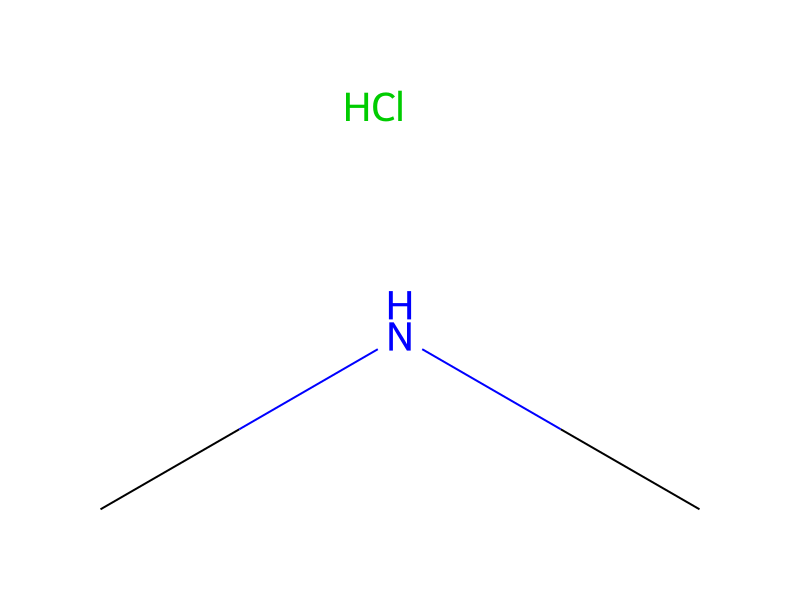

Produkt 1

Reagenzien, Katalysatoren, Lösungsmittel 1

Versuchsvorschrift
One example of a known method for producing N,N-dimethyl-3-hydroxy-3-(2-thienyl)propanamine uses the reaction between 2-acetylthiophene and dimethylamine hydrochloride in isopropanol in the presence of paraformaldehyde and hydrochloric acid to obtain (2-thienyl)(2-dimethylaminoethyl)ketone, and the (2-thienyl)(2-dimethylaminoethyl)ketone is reduced using sodium borohydride in ethanol (JP 7-188065 A). If N-monoalkyl-3-hydroxy-3-(2-thienyl)propanamine is produced in the same method as described above except that a monoalkylamine hydrochloride is used instead of the dimethylamine hydrochloride, since the production intermediate, i.e., (2-thienyl)(2-monoalkylaminoethyl)ketone, is unstable, an N,N′,N″-alkyl-bis[1-[3-oxo-3-(2-thienyl)propane]]amine, which is a dimer, is produced, and therefore the yield of the N-monoalkyl-3-hydroxy-3-(2-thienyl)propanamine obtained after the reduction using sodium borohydride is low.
Quellen und Nachweise
- ORD-Eintrag
- ord-a588b76f7e0144fcb43006ca7956443c
- Quelldatensatz
- uspto-grants-2014_05
- Patentnummer
- US08722906B2
Notizen zur Reaktion
Wird geladen…