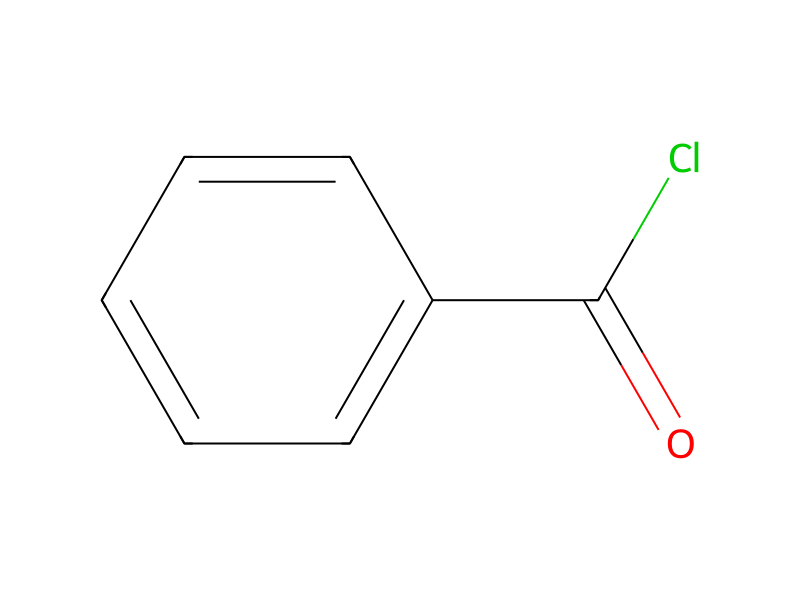
[C:1]([Cl:9])(=[O:8])[C:2]1[CH:7]=[CH:6][CH:5]=[CH:4][CH:3]=1.C(N(CC)CC)C.[NH2:17][C:18]1[N:23]=[C:22]([N:24]2[CH2:29][CH2:28][O:27][CH2:26][CH2:25]2)[N:21]=[C:20]([CH2:30][CH2:31][CH3:32])[N:19]=1>ClC(Cl)C>[ClH:9].[O:27]1[CH2:26][CH2:25][N:24]([C:22]2[N:21]=[C:20]([CH2:30][CH2:31][CH3:32])[N:19]=[C:18]([NH:17][C:1](=[O:8])[C:2]3[CH:7]=[CH:6][CH:5]=[CH:4][CH:3]=3)[N:23]=2)[CH2:29][CH2:28]1A solution of 7.7 g (0.055 mole) of benzoyl chloride in 50 ml of dichloroethane and a solution of 5.5 g (0.055 mole) of triethylamine in 50 ml of dichloroethane are successively added into a solution of 11.2 @(0.05 mole) of 2-amino-4-morpholino-6-propyl-1.3.5-triazine in 200 ml of dichloroethane at room temperature. The mixture is heated under reflux for 6 hours and cooled to room temperature. It is washed successively with water, with an aqueous solution of sodium bicarbonate and then with water once again. The organic phase is dried over sodium sulfate and the solvent is evaporated under reduced pressure. The residue obtained is chromatographed on silica (eluent: 95:5 (v/v) dichloromethane-ethanol) and finally recrystallized from a 50:50 mixture (v/v) of diethyl ether-hexane. The product forms a hydrochloride in the diethyl ether. 12.1 g of N-(4-morpholino-6-propyl-1,3,5-triazin-2-yl)-benzamide hydrochloride are thus obtained. Yield: 66.5%. M.P.: I97°-198° C.