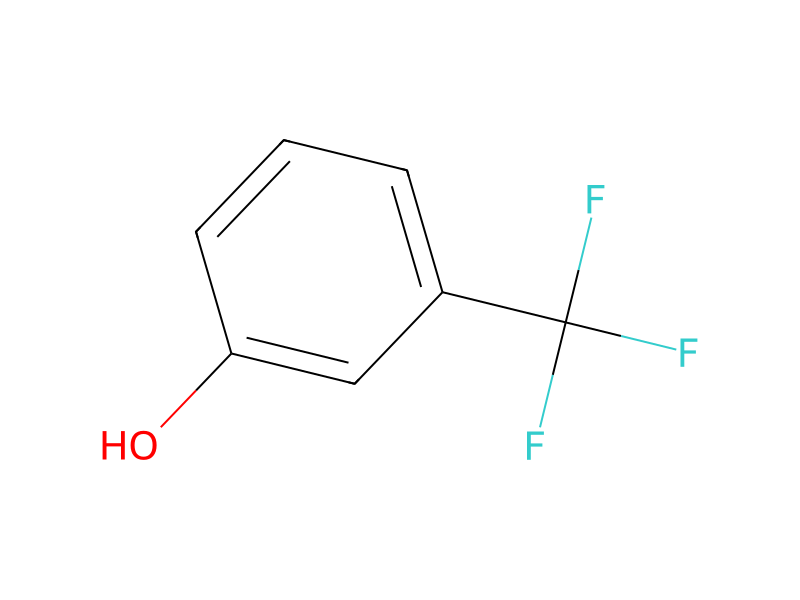
[OH:1][C:2]1[CH:7]=[C:6]([Cl:8])[N:5]=[N:4][C:3]=1Cl.[F:10][C:11]([F:20])([F:19])[C:12]1[CH:13]=[C:14]([OH:18])[CH:15]=[CH:16][CH:17]=1.[OH-].[Na+].Cl>O.CS(C)=O.ClC1C=CC=CC=1Cl>[Cl:8][C:6]1[N:5]=[N:4][C:3]([O:18][C:14]2[CH:15]=[CH:16][CH:17]=[C:12]([C:11]([F:10])([F:19])[F:20])[CH:13]=2)=[C:2]([OH:1])[CH:7]=13.0 g (purity: 90%; 16.4 mmol) of 4-hydroxy-3,6-dichloropyridazine, 7.96 g (49.1 mmol) of 3-trifluoromethylphenol, and 2.03 g (purity: 97%; 49.1 mmol) of sodium hydroxide were added to a mixture of 19.1 g of 1,2-dichlorobenzene and 3.0 g of dimethyl sulfoxide and matured at 180° C. for 8 hours. After completion of the reaction, the reaction mixture was cooled to room temperature, and 50 g of pure water was added to the cooled mixture. A 35% aqueous hydrochloric acid solution was added to the resultant mixture so that the pH of the aqueous phase was adjusted to 2.1, and then the deposited solids were taken out by filtration. 25 mL of methyl t-butyl ether was added to the solids to obtain a slurry. The resultant solids were dried under a reduced pressure to obtain 3.32 g of 6-chloro-3-[3-(trifluoromethyl)phenoxy]-4-pyridazinol in the form of pale brown solids (yield: 69.7%).