Reaktionsgleichung

Br[C:2]1[C:10]2[C:6](=[N:7][S:8][N:9]=2)[C:5](Br)=[CH:4][CH:3]=1.C1(N(C2C=CC(B(O)O)=CC=2)C2C=CC=CC=2)C=CC=CC=1.C(=O)([O-])[O-].[Na+].[Na+].C(O)CCC>O.C1C=CC([P]([Pd]([P](C2C=CC=CC=2)(C2C=CC=CC=2)C2C=CC=CC=2)([P](C2C=CC=CC=2)(C2C=CC=CC=2)C2C=CC=CC=2)[P](C2C=CC=CC=2)(C2C=CC=CC=2)C2C=CC=CC=2)(C2C=CC=CC=2)C2C=CC=CC=2)=CC=1.C1(C)C=CC=CC=1>[N:7]1[S:8][N:9]=[C:10]2[CH:2]=[CH:3][CH:4]=[CH:5][C:6]=12Komponenten
Edukt 4




Produkt 1
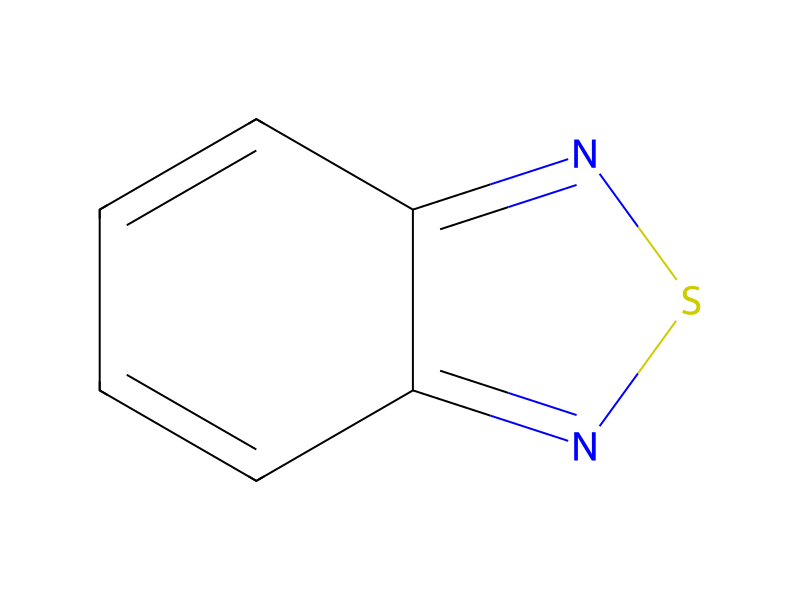
Reagenzien, Katalysatoren, Lösungsmittel 3



Reaktionsbedingungen
- Temperatur
- 100 °C
Versuchsvorschrift
A mixture of 4,7-dibromobenzo[2,1,3]thiadiazole (13.2 g, 45 mmol), 4-(N,N-diphenylamino)phenylboronic acid (30.0 g, 104 mmol), a solution of sodium carbonate (21.2 g, 200 mmol) in water (80 mL), tetrakis(triphenylphosphine)palladium(0) (5.0 g, 4.3 mmol), n-butanol (800 mL), and toluene (400 mL) was stirred under argon and heated at 100° C. for 20 hours. After cooling to room temperature, the mixture was diluted with water (600 mL) and stirred for 2 hours. Finally, the reaction mixture was extracted with toluene (2 L), and the volatiles were removed under reduced pressure. The residue was chromatographed using silica gel and hexane/dichloromethane (1:1) as an eluent to give 26.96 g (43.3 mmol, 96%) of 4,7-bis[(N,N-diphenylamino)phenyl)]benzo[2,1,3]thiadiazole (Intermediate M).
Aufarbeitung
- temperatureAfter cooling to room temperature
- extractionFinally, the reaction mixture was extracted with toluene (2 L)
- customthe volatiles were removed under reduced pressure
- customThe residue was chromatographed
Quellen und Nachweise
- ORD-Eintrag
- ord-367db1714ccb420ea4bf501fceef4da4
- Quelldatensatz
- uspto-grants-2016_07
- Patentnummer
- US09382424B2
Verknüpfte Notizen
Wird geladen…