StartseiteMCPWorkbenchSkills
StartseiteWorkbenchBenachrichtigungenMein Bereich
llms.txt · MCP-AnleitungDatenschutz · Nutzungsbedingungen · Supportv1.8.3
  1. Startseite
  2. /Reaktion

4-Methylmorpholine → 1-(2-cyclopropyl-2-(2-pyridyl)hydroxyacetyl)-N-(2-(tert-butyloxycarbonylaminomethyl)-5-chlorobenzyl)-L-prolinamide

HRID 1058287
Drucken

Reaktionsgleichung

Reaktionsgleichung von HRID 1058287
[C:1]([O:5][C:6]([NH:8][CH2:9][C:10]1[CH:24]=[CH:23][C:22]([Cl:25])=[CH:21][C:11]=1[CH2:12][NH:13][C:14](=[O:20])[C@@H:15]1[CH2:19][CH2:18][CH2:17][NH:16]1)=[O:7])([CH3:4])([CH3:3])[CH3:2].[Na].[CH:27]1([C:30]([OH:40])([C:34]2[CH:39]=[CH:38][CH:37]=[CH:36][N:35]=2)[C:31](O)=[O:32])[CH2:29][CH2:28]1.CN1CCOCC1.CN([P+](ON1N=NC2C=CC=CC1=2)(N(C)C)N(C)C)C.F[P-](F)(F)(F)(F)F>CN(C=O)C>[CH:27]1([C:30]([OH:40])([C:34]2[CH:39]=[CH:38][CH:37]=[CH:36][N:35]=2)[C:31]([N:16]2[CH2:17][CH2:18][CH2:19][C@H:15]2[C:14]([NH:13][CH2:12][C:11]2[CH:21]=[C:22]([Cl:25])[CH:23]=[CH:24][C:10]=2[CH2:9][NH:8][C:6]([O:5][C:1]([CH3:4])([CH3:2])[CH3:3])=[O:7])=[O:20])=[O:32])[CH2:29][CH2:28]1

KomponentenVersuchsvorschriftAufarbeitungQuellen und NachweiseNotizen zur Reaktion

Komponenten

7

Edukt 5

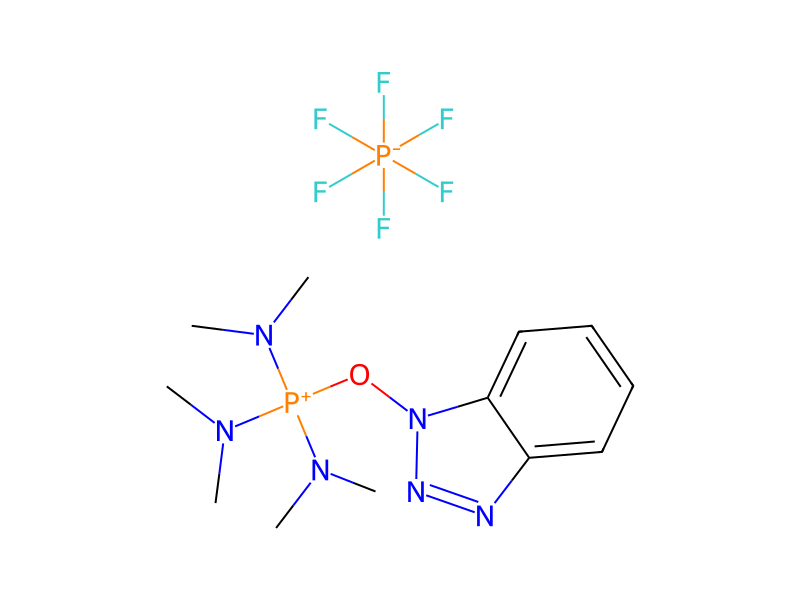
HCID 79724-MethylmorpholineHCID 151348Benzotriazol-1-yloxy-tris(dimethylamino)phosphonium hexafluorophosphateHCID 5360545SodiumHCID 11428605L-prolin-N-(2-(tert-butyloxycarbonylaminomethyl)-5-chlorobenzyl)amideHCID 186723062-Cyclopropyl-2-(2-pyridyl)hydroxyacetic acid

Produkt 1

HCID 69939298
1-(2-cyclopropyl-2-(2-pyridyl)hydroxyacetyl)-N-(2-(tert-butyloxycarbonylaminomethyl)-5-chlorobenzyl)-L-prolinamide

Reagenzien, Katalysatoren, Lösungsmittel 1

HCID 6228DimethylformamideLösungsmittel

Versuchsvorschrift

To a stirred solution of L-prolin-N-(2-(tert-butyloxycarbonylaminomethyl)-5-chlorobenzyl)amide (120 mg, 0.316 mmol), the sodium salt of 2-cyclopropyl-2-(2-pyridyl)hydroxyacetic acid from the previous step (63 mg, 0.326 mmol), and NMM (36 μL, 0.326 mmol) in DMF (5 mL) at ambient temperature under nitrogen atmosphere was added BOP reagent (173 mg, 0.391 mmol). The mixture was stirred at ambient temperature for 3 h. The solvent was removed under reduced pressure. The residue was partitioned between EtOAc (100 mL) and saturated aqueous NaHCO3 (100 mL). The EtOAc layer was separated, dried over anhydrous Na2SO4, and filtered. The filtrate solvent was removed under reduced pressure and the residue was purified by preparative reverse phase HPLC using a gradient of 95:5 to 0:100 (water:CH3CN containing 0.1% TFA) over 60 min with a flow rate of 60 mL/min. After concentration of desired fractions in vacuo, the two diastereomers of 1-(2-cyclopropyl-2-(2-pyridyl)hydroxyacetyl)-N-(2-(tert-butyloxycarbonylaminomethyl)-5-chlorobenzyl)-L-prolinamide were obtained as amorphous solids (isomer 1 (less polar) 50 mg; HPLC RT=3.06 min, method A; LC-MS m/z=543.2; 1H NMR, 400 MHz, CDCl3, 7.81 ppm (d, 1H), 7.74 ppm (t, 2H), 7.28 ppm (d, 2H), 7.22 ppm (d, 1H), 7.14 ppm (t, 1H), 5.45 ppm (br s, 1H), 5.0 ppm (br s, 1H), 4.8 ppm (d, 1H), 4.6 ppm (dd, 1H), 4.42 ppm (d, 1H), 4.35 ppm (m, 1H), 4.2 ppm (m, 1H), 3.43 ppm (m, 1H), 3.1 ppm (br t, 1H), 2.25 ppm (m, 1H), 2.1 ppm (m, 1H), 1.8 ppm (m, 2H), 1.48 ppm (m, 1H), 1.45 ppm (s, 9H), 1.0 ppm (m, 1H), 0.85 ppm (m, 1H), 0.65 ppm (m, 1H), 0.5 ppm (m, 1H); isomer 2 (more polar)38 mg; HPLC RT=2.99 min, method A; LC-MS m/z=543.2).

Aufarbeitung

  1. customThe solvent was removed under reduced pressure
  2. customThe residue was partitioned between EtOAc (100 mL) and saturated aqueous NaHCO3 (100 mL)
  3. customThe EtOAc layer was separated
  4. dry with materialdried over anhydrous Na2SO4
  5. filtrationfiltered
  6. customThe filtrate solvent was removed under reduced pressure
  7. customthe residue was purified by preparative reverse phase HPLC
  8. customover 60 min

Quellen und Nachweise

ORD-Eintrag
ord-35a53e6619d04e34b86e1c142a61fe07
Quelldatensatz
uspto-grants-2003_02
DOI
10.6084/m9.figshare.5104873.v1
Patentnummer
US06515011B2

Notizen zur Reaktion

Auf dieser SeiteKomponentenVersuchsvorschriftAufarbeitungQuellen und NachweiseNotizen zur Reaktion

