Reaktionsgleichung

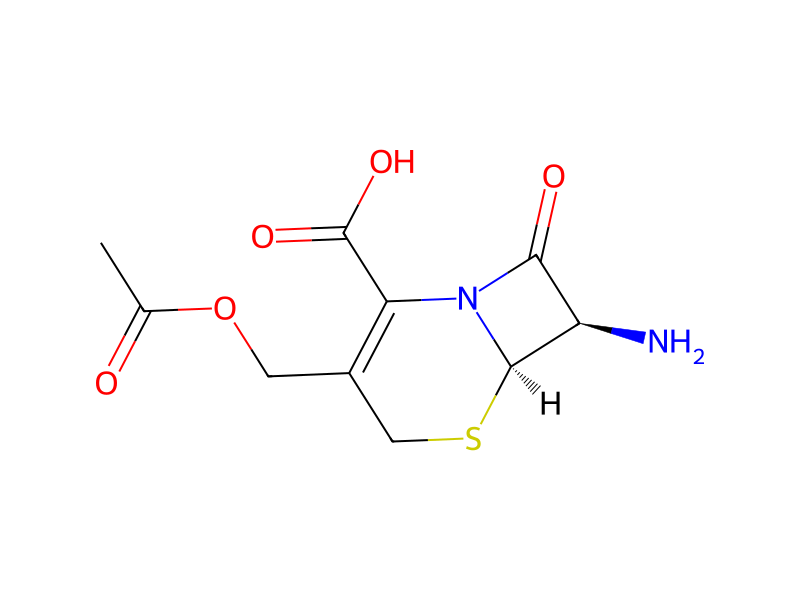
[CH3:1][C:2]([O:4][CH2:5][C:6]1[CH2:25][S:24][C@@H:9]2[C@H:10]([NH:13]C(CCC[C@@H](N)C(O)=O)=O)[C:11](=[O:12])[N:8]2[C:7]=1[C:26]([OH:28])=[O:27])=[O:3].CC(OCC1CS[C@@H]2[C@H](NC(CCCC(O)=O)=O)C(=O)N2C=1C(O)=O)=O>>[CH3:1][C:2]([O:4][CH2:5][C:6]1[CH2:25][S:24][C@@H:9]2[C@H:10]([NH2:13])[C:11](=[O:12])[N:8]2[C:7]=1[C:26]([OH:28])=[O:27])=[O:3]Komponenten


Versuchsvorschrift
or enzymatically, e.g. by action of an acylase; or by conversion of cephalosporin C into glutaryl-7-amino-cephalosporanic acid, e.g. by action of a D-amino acid oxidase, enzymatically hydrolysing a glutaryl-7-amino cephalosporanic acid to obtain 7-ACA, e.g. in a basic medium, neutral or slightly acidic medium, optionally purifying the reaction solution with an appropriate ion exchanger or adsorber resin, and precipitating 7-ACA, e.g. by adjustment of the pH (around the isoelectric point), e.g. by addition of an acid, e.g. HCl. In that case precipitated 7-ACA may be, however, in the form of very small, loose, needle-like crystals difficult to be isolated. Increasing purity of 7-ACA may result in still smaller crystals and addition of an organic solvent, e.g. a, e.g. lower, alcohol, e.g. methanol or a ketone, e.g. acetone, to the reaction mixture before the isolation of 7-ACA, which may improve the yield, again may result in considerably smaller crystals.
Quellen und Nachweise
- ORD-Eintrag
- ord-eb9714820f7e47a0bdd5e51387fdec49
- Quelldatensatz
- uspto-grants-2003_02
- Patentnummer
- US06518420B2
Verknüpfte Notizen
Wird geladen…