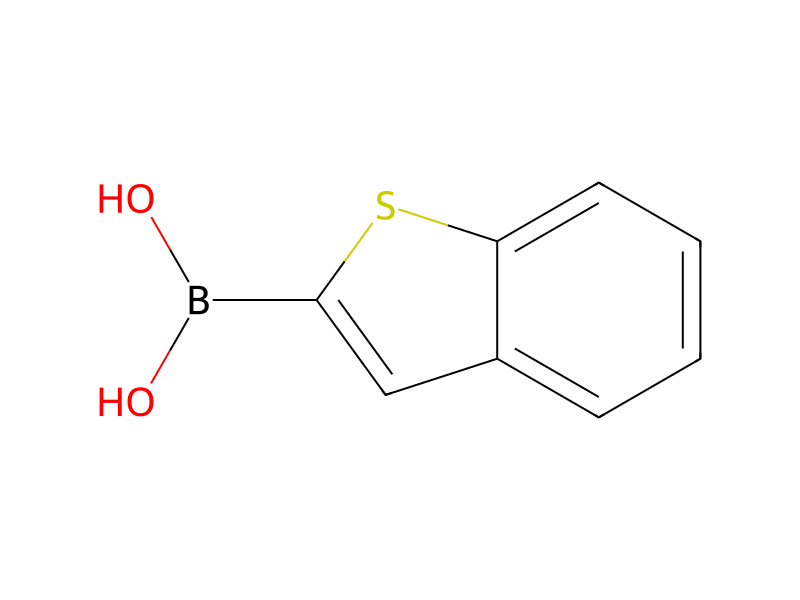
Br[C:2]1[C:3]([O:12][CH3:13])=[CH:4][C:5]([O:10][CH3:11])=[C:6]([CH:9]=1)[CH:7]=[O:8].[S:14]1[C:18](B(O)O)=[CH:17][C:16]2[CH:22]=[CH:23][CH:24]=[CH:25][C:15]1=2.C(=O)([O-])[O-].[Na+].[Na+].O>COCCOC.C1C=CC([P]([Pd]([P](C2C=CC=CC=2)(C2C=CC=CC=2)C2C=CC=CC=2)([P](C2C=CC=CC=2)(C2C=CC=CC=2)C2C=CC=CC=2)[P](C2C=CC=CC=2)(C2C=CC=CC=2)C2C=CC=CC=2)(C2C=CC=CC=2)C2C=CC=CC=2)=CC=1>[S:14]1[C:18]([C:2]2[C:3]([O:12][CH3:13])=[CH:4][C:5]([O:10][CH3:11])=[C:6]([CH:9]=2)[CH:7]=[O:8])=[CH:17][C:16]2[CH:22]=[CH:23][CH:24]=[CH:25][C:15]1=2Ex-3A: A sample of 5-bromo-2,4-dimethoxybenzaldehyde (4.9 g, 20.0 mmol) was dissolved in ethylene glycol dimethyl ether (50 mL). Tetrakis(triphenylphosphine)palladium(0) (2.32 g, 2 mmol) was added, and the mixture was stirred at room temperature under nitrogen for 5 min. Benzo[b]thiophene-2-boronic acid (4.27 g, 24 mmol) and sodium carbonate solution (2 M, 20 mL) were added. The mixture was stirred at reflux under nitrogen for 24 hours. Upon cooling to room temperature, the mixture was poured into water and extracted with ethyl acetate. The organic phase was dried over sodium sulfate and evaporated. Silica gel chromatography (hexane/ethyl acetate 2:1 then 1:1) gave 4.75 g (83%) of the desired 5-(benzo[b]thien-2-yl)-2,4-dimethoxybenzaldehyde. 1H NMR (CDCl3) δ 10.36 (s, 1H), 8.20 (s, 1H), 7.83–7.78 (m, 2H), 7.68 (s, 1H), 7.36–7.27 (m, 2H), 6.54 (s, 1H), 4.06 (s, 3H), 4.00 (s, 3H).
Wird geladen…