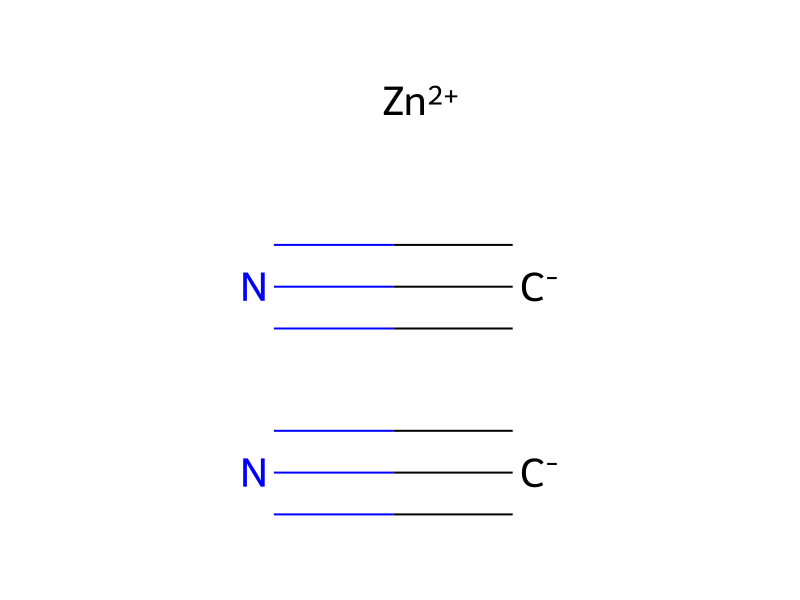
Br[C:2]1[CH:3]=[C:4]([C:9]2[N:10]=[C:11]([C:15]3[CH:20]=[CH:19][C:18]([F:21])=[CH:17][C:16]=3[F:22])[N:12]=[N:13][CH:14]=2)[CH:5]=[CH:6][C:7]=1[F:8].[CH3:23][N:24](C)C=O>[C-]#N.[Zn+2].[C-]#N.C1C=CC([P]([Pd]([P](C2C=CC=CC=2)(C2C=CC=CC=2)C2C=CC=CC=2)([P](C2C=CC=CC=2)(C2C=CC=CC=2)C2C=CC=CC=2)[P](C2C=CC=CC=2)(C2C=CC=CC=2)C2C=CC=CC=2)(C2C=CC=CC=2)C2C=CC=CC=2)=CC=1>[F:22][C:16]1[CH:17]=[C:18]([F:21])[CH:19]=[CH:20][C:15]=1[C:11]1[N:12]=[N:13][CH:14]=[C:9]([C:4]2[CH:5]=[CH:6][C:7]([F:8])=[C:2]([CH:3]=2)[C:23]#[N:24])[N:10]=1A mixture of 5-(3-bromo-4-fluorophenyl)-3-(2,4-difluorophenyl)-[1,2,4]triazine (0.1 g, 0.27 mmol), zinc cyanide (0.032 g, 0.27 mmol) and tetrakis(triphenylphosphine)palladium(0) (0.016 g, 0.01 mmol) in N,N-dimethylformamide (4 ml) was heated to 150° C. Fog 600 s in a Smith Synthesiser microwave reactor (Personal Chemistry, Uppsala, Sweden). The reaction was partitioned between ethyl acetate (80 ml) and water (40 ml). The organic layer was washed with water (40 ml) and the combined organics dried over Mg2SO4, filtered and the solvent removed at reduced pressure. The crude product was chromatographed on silica gel, eluent 50% ethyl acetate in isohexane, to give 5-[3-(2,4-difluorophenyl)-[1,2,4]triazin-5-yl]-2-fluorobenzonitrile as a yellow solid (0.054 g): δH (400 MHz, CDCl3) 7.02-7.14 (2H, m), 7.48 (1H, t, J 8.6 Hz), 8.33-8.39 (1H, m), 8.49-8.53 (1H, m), 8.62 (1H, dd, J 2.2, 6.1 Hz), 9.65 (1H, s); m/z(ES+) 313.