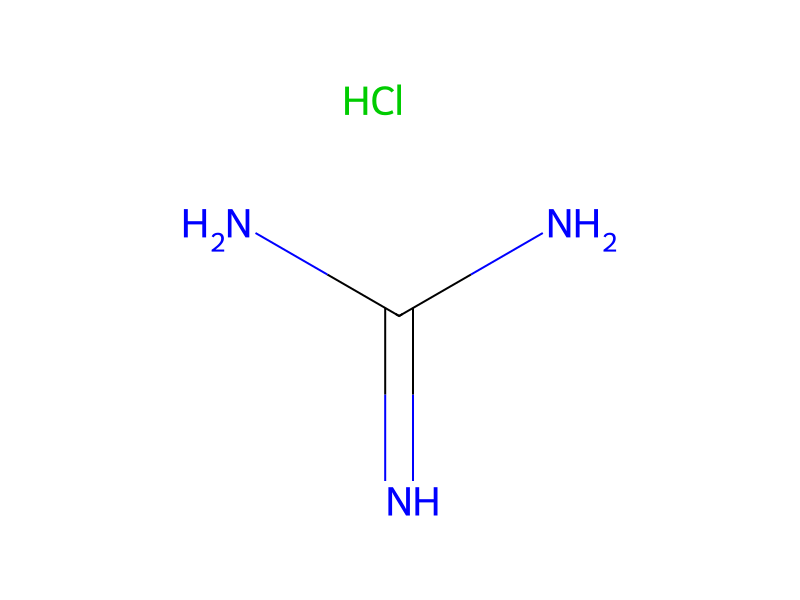
Cl.[NH2:2][C:3]([NH2:5])=[NH:4].[H-].[Na+].Cl[C:9]1[C:18]2[C:13](=[CH:14][CH:15]=[C:16]([S:19](=[O:22])(=[O:21])[NH2:20])[CH:17]=2)[C:12]([Cl:23])=[CH:11][N:10]=1>CS(C)=O>[Cl:23][C:12]1[C:13]2[C:18](=[CH:17][C:16]([S:19](=[O:22])(=[O:21])[NH2:20])=[CH:15][CH:14]=2)[C:9]([NH:4][C:3]([NH2:5])=[NH:2])=[N:10][CH:11]=1Guanidine hydrochloride (70 mg, 0.73 mmol) was added in one portion to a suspension of NaH (21 mg, 80% dispersion by wt in mineral oil, 0.66 mmol) in DMSO (2.0 mL) and the mixture was heated at 50° C. under N2 for 30 min. 1,4-Dichloro-7-sulphamoylisoquinoline (70 mg, 0.25 mmol) was added and the mixture heated at 90° C. for 18 h. The cooled mixture was partitioned between ethyl acetate (EtOAc) and water, and the organic phase was washed with brine, dried (MgSO4) and evaporated in vacuo. The residue was purified by column chromatography upon silica gel using CH2Cl2—MeOH-0.880NH3 (95:5:0.5 to 90:10:1) as eluant to give 4-chloro-1-guanidino-7-sulphamoylisoquinoline (50 mg, 0.167 mmol) as a white solid.