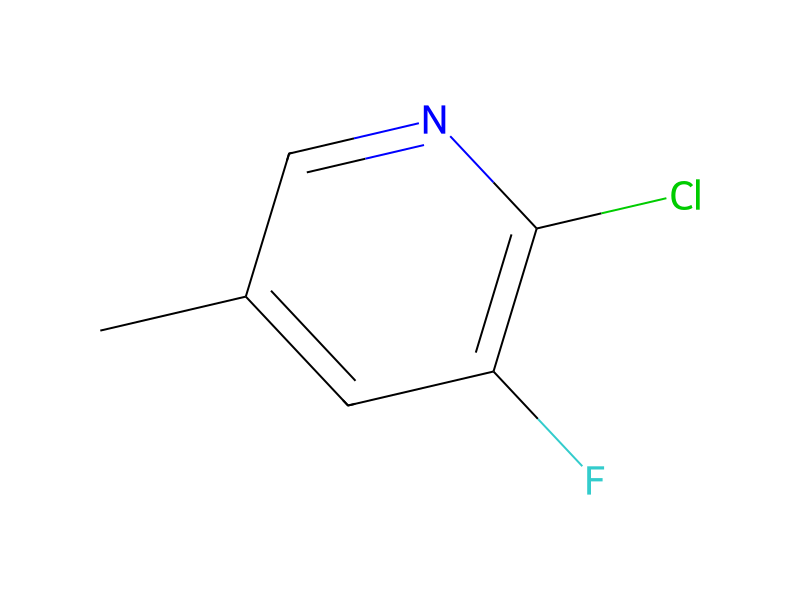
1.00 g (6.87 mmol) of 6-chloro-5-fluoro-3-methylpyridine (F. L. Setliff, Organic Preparations and Procedures International 1971, 3, 217-222), 1.01 g (7.56 mmol) of N-chlorosuccinimide and 0.11 g (0.69 mmol) of 2,2′-azobis(2-methylpropannitrile) in 100 ml of chlorobenzene are boiled under reflux for 2 days. During this reaction, after about 16 hours and 32 hours, a further 1.01 g (7.56 mmol) of N-chlorosuccinimide and 0.11 g (0.69 mmol) of 2,2′-azobis(2-methylpropannitrile) are added in each case. The reaction mixture is washed with saturated aqueous sodium sulphite solution and sodium bicarbonate solution and then dried over sodium sulphite and concentrated under reduced pressure. Column chromatography of the residue on silica gel (silica gel 60-Merck, particle size: 0.04 to 0.063 mm) using the mobile phase mixture ethyl acetate:cyclohexane (1:20) gives 0.65 g (53% of theory) of 6-chloro-3-chloromethyl-5-fluoropyridine.