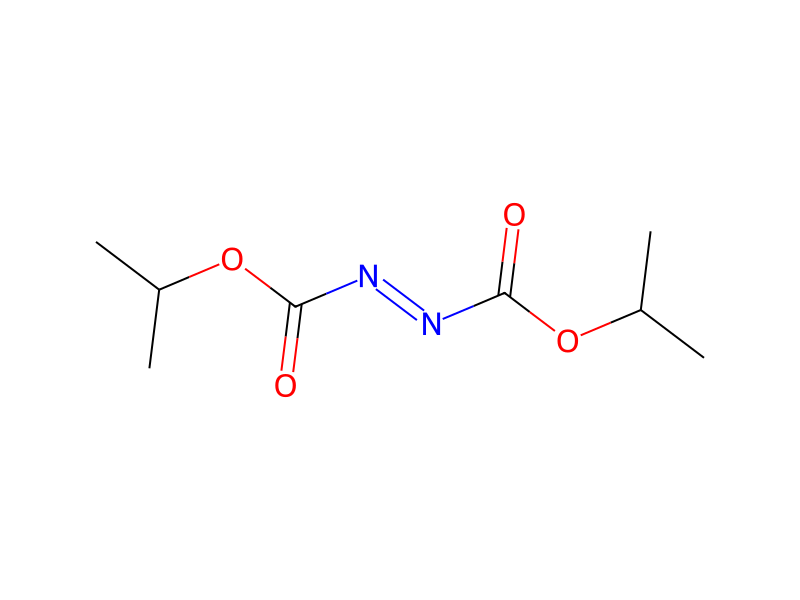
[OH:1][C:2]1[CH:11]=[CH:10][C:9]([N+:12]([O-:14])=[O:13])=[CH:8][C:3]=1[C:4]([O:6][CH3:7])=[O:5].[C:15]1(P(C2C=CC=CC=2)C2C=CC=CC=2)[CH:20]=CC=C[CH:16]=1.CC(O)C.C(OC(N=NC(OC(C)C)=O)=O)(C)C>C1COCC1>[CH:15]([O:1][C:2]1[CH:11]=[CH:10][C:9]([N+:12]([O-:14])=[O:13])=[CH:8][C:3]=1[C:4]([O:6][CH3:7])=[O:5])([CH3:20])[CH3:16]Methyl 2-hydroxy-5-nitrobenzoate (11.82 g, 60 mmol), triphenylphosphine (17.29 g, 66 mmol) and iPrOH (3.96 g, 5 ml, 66 mmol) were taken up in THF (150 ml) and cooled in ice. Di-isopropyl-azodicarboxylate (8.31 g, 10 ml, 66 mmol) was added carefully, and the reaction was stirred at RT overnight. The volatiles were removed in vacuo and the residue treated with EtOAc (50 ml). The solids that didn't dissolve were removed by filtration, and the filtrate evaporated to dryness in vacuo. The residue was purified by column chromatography to give methyl 2-isopropoxy-5-nitrobenzoate (6.92 g, 48.5%) as a yellow oil.