Reaktionsgleichung

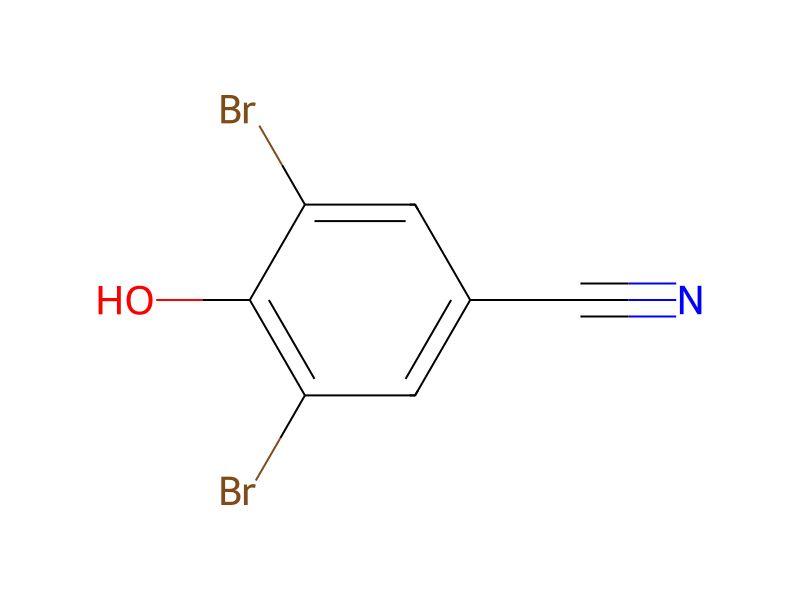
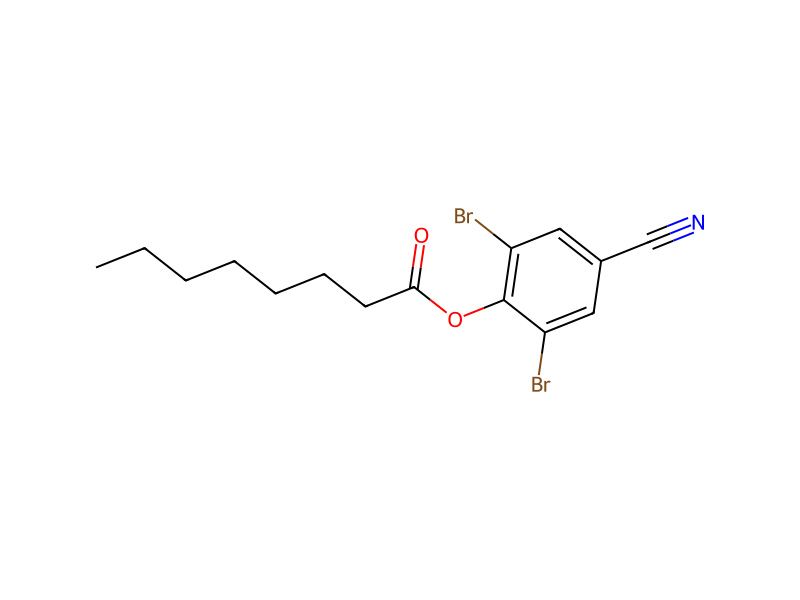
[Br:1][C:2]1[CH:3]=[C:4]([CH:7]=[C:8]([Br:11])[C:9]=1[OH:10])[C:5]#[N:6].[Cl-].[Na+].O.[C:15](Cl)(=[O:23])[CH2:16][CH2:17][CH2:18][CH2:19][CH2:20][CH2:21][CH3:22]>[Cl-].C([N+](CCCC)(CCCC)CCCC)C1C=CC=CC=1.C1(C)C=CC=CC=1>[C:15]([O:10][C:9]1[C:2]([Br:1])=[CH:3][C:4]([C:5]#[N:6])=[CH:7][C:8]=1[Br:11])(=[O:23])[CH2:16][CH2:17][CH2:18][CH2:19][CH2:20][CH2:21][CH3:22]Komponenten
Edukt 4



Produkt 1
Reagenzien, Katalysatoren, Lösungsmittel 2


Versuchsvorschrift
A mixture of 3,5-dibromo-4-hydroxybenzonitrile (27.69 g) sodium hydroxide (4.08 g), sodium chloride (43.4 g) and water (125 ml) was stirred at room temperature for 15 minutes. Toluene (30 ml) and benzyltributyl ammonium chloride (1.57 g) was added, and a solution of octanoyl chloride (17.06 g) in toluene (30 ml) was slowly added to the stirred mixture over a half an hour while the temperature was maintained at 20° C. After addition was completed, the mixture was stirred for 1 hour and the phases allowed to separate. After removing the aqueous phase, the organic phase was washed with water, then with 5% aqueous Na2O3 and again with water. The solution was dried over Na2O3 and evaporated to dryness, yielding 2,6-dibromo-4-cyanophenyl octanoate (40.08 g, 99.5%) as a brown crystalline solid.
Aufarbeitung
- temperaturewas maintained at 20° C
- additionAfter addition
- stirringthe mixture was stirred for 1 hour
- customto separate
- customAfter removing the aqueous phase
- washthe organic phase was washed with water
- customThe solution was dried over Na2O3
- customevaporated to dryness
Quellen und Nachweise
- ORD-Eintrag
- ord-6b34abb3608d4ff193e9d95799fa4b5f
- Quelldatensatz
- uspto-grants-1990_12
- Patentnummer
- US04980493
Verknüpfte Notizen
Wird geladen…