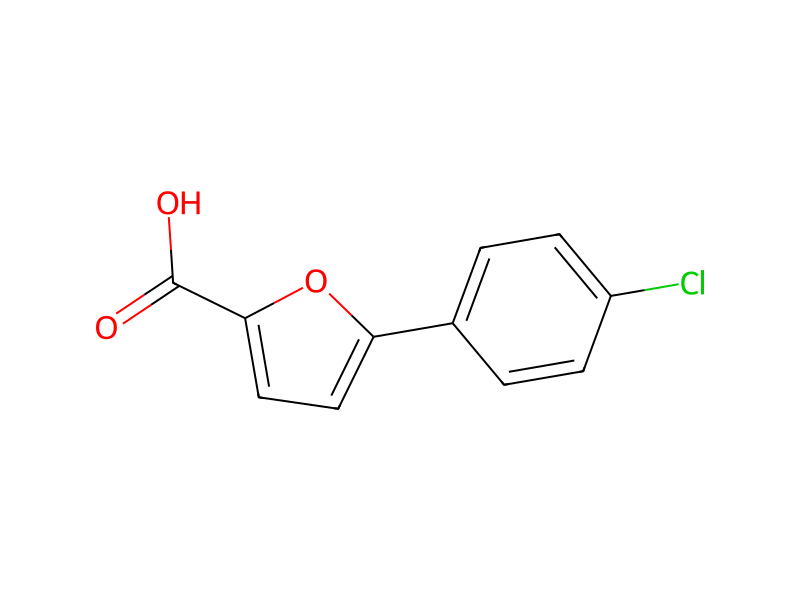
[Cl:1][C:2]1[CH:7]=[CH:6][C:5]([C:8]2[O:12][C:11]([C:13]([OH:15])=O)=[CH:10][CH:9]=2)=[CH:4][CH:3]=1.S(Cl)(Cl)=O.[Br:20][C:21]1[CH:22]=[C:23]([N:27]2[CH2:32][CH2:31][NH:30][CH2:29][CH2:28]2)[CH:24]=[CH:25][CH:26]=1.C(N(CC)CC)C>C1C=CC=CC=1.O>[Cl:1][C:2]1[CH:3]=[CH:4][C:5]([C:8]2[O:12][C:11]([C:13]([N:30]3[CH2:29][CH2:28][N:27]([C:23]4[CH:24]=[CH:25][CH:26]=[C:21]([Br:20])[CH:22]=4)[CH2:32][CH2:31]3)=[O:15])=[CH:10][CH:9]=2)=[CH:6][CH:7]=15-(4-Chlorophenyl)-2-furoic acid (Australian Journal of Chemistry, 26, 1147 (1973))(6.67 g; 0.03 mole) was refluxed in benzene (100 ml) with thionyl chloride (4.5 ml) for 1.5 hours. After removal of the excess thionyl chloride, the remaining acid chloride in benzene was added dropwise with stirring and cooling to a mixture of N-(3-bromophenyl)-piperazine (7.23 g; 0.03 mole) and triethylamine (4.5 ml, ca. 0.03 mole) in benzene (100 ml). After stirring for 1 hour at room temperature, the mixture was shaken with water (100 ml). The separated benzene phase was further washed with saturated salt solution, then evaporated to give an oil which readily crystallised. The product was recrystallised from ethyl acetate/60°-80° C. petroleum ether (1/3 v /v) to yield 1-[5-(4-chlorophenyl)-2-furoyl]-4-(3-bromophenyl)-piperazine (12.3 g) m.p. 130° C.
Wird geladen…