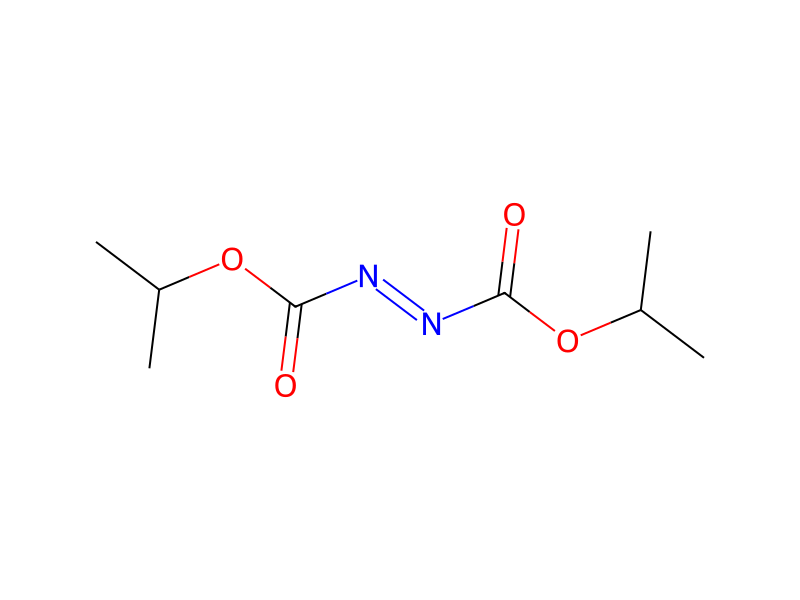
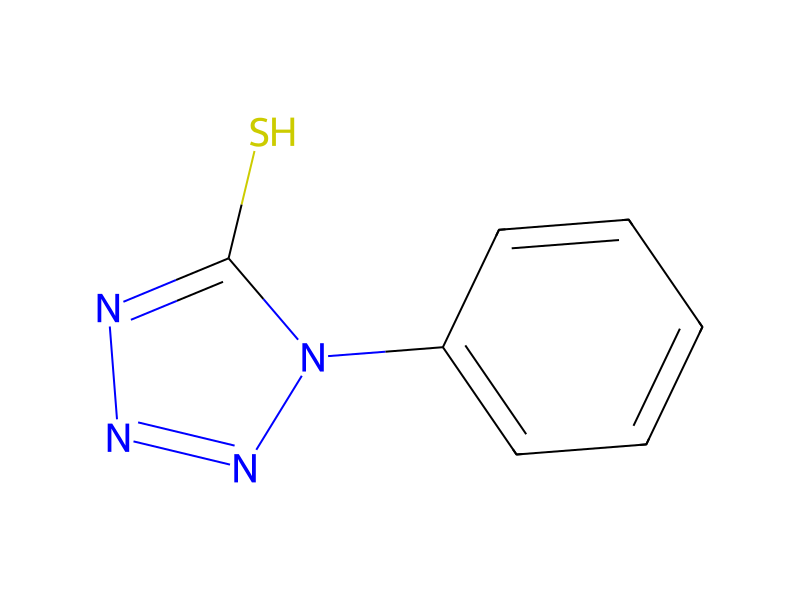
[SH:1][C:2]1[N:6]([C:7]2[CH:12]=[CH:11][CH:10]=[CH:9][CH:8]=2)[N:5]=[N:4][N:3]=1.C1(P(C2C=CC=CC=2)C2C=CC=CC=2)C=CC=CC=1.N(C(OC(C)C)=O)=NC(OC(C)C)=O.[CH3:46][O:47][C:48](=[O:55])/[CH:49]=[C:50](\[CH3:54])/[CH2:51][CH2:52]O>C(OCC)(=O)C.C1COCC1>[CH3:46][O:47][C:48](=[O:55])/[CH:49]=[C:50](\[CH3:54])/[CH2:51][CH2:52][S:1][C:2]1[N:6]([C:7]2[CH:12]=[CH:11][CH:10]=[CH:9][CH:8]=2)[N:5]=[N:4][N:3]=15-Mercapto-1-phenyltetrazole (2.62 g, 14.60 mmol), triphenylphosphine (3.83 g, 14.60 mmol) and diisopropyl azodicarboxylate (95%, 2.96 g, 14.60 mmol) were added to a THF (36.8 ml) solution of methyl-(2E)-5-hydroxy-3-methylpent-2-enoate (1.16 g, 7.31 mmol) while ice cooling. The reaction solution was warmed to room temperature and stirred for two hours. After the reaction solution was diluted with ethyl acetate, it was washed with distilled water and brine. After the organic layer was dried over anhydrous sodium sulfate and the drying agent was filtered off, the organic layer was concentrated under reduced pressure. The obtained residue was purified by silica gel column chromatography (Merck, commercial name Silica Gel 60, 230-400 mesh; hexane:ethyl acetate=5:1) to obtain the title compound (2.33 g) as a white solid.