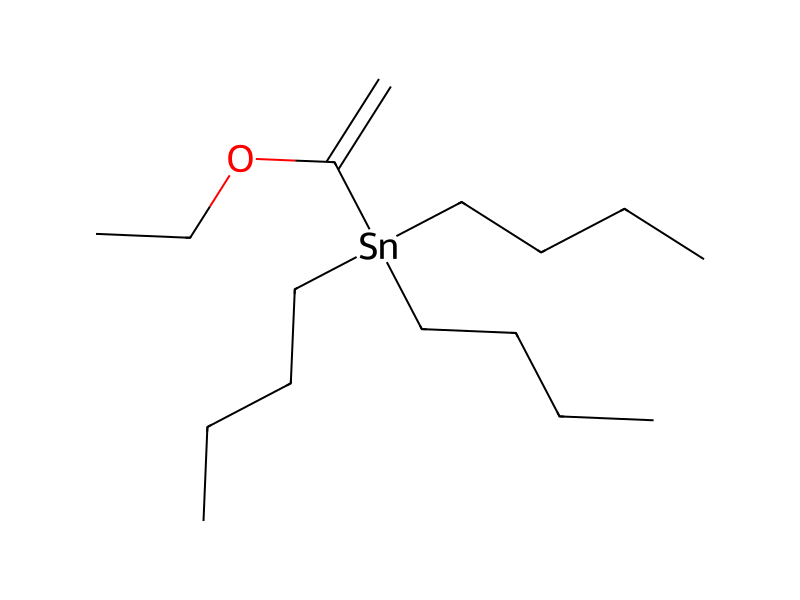
Br[C:2]1[CH:3]=[C:4]([C:19]([O:21][CH3:22])=[O:20])[CH:5]=[C:6]2[C:11]=1[O:10][C:9]([N:12]1[CH2:17][CH2:16][O:15][CH2:14][CH2:13]1)=[CH:8][C:7]2=[O:18].C([Sn](CCCC)(CCCC)[C:28]([O:30]CC)=[CH2:29])CCC.Cl>O1CCOCC1.[Pd](Cl)Cl.C1(P(C2C=CC=CC=2)C2C=CC=CC=2)C=CC=CC=1.C1(P(C2C=CC=CC=2)C2C=CC=CC=2)C=CC=CC=1>[C:28]([C:2]1[CH:3]=[C:4]([C:19]([O:21][CH3:22])=[O:20])[CH:5]=[C:6]2[C:11]=1[O:10][C:9]([N:12]1[CH2:17][CH2:16][O:15][CH2:14][CH2:13]1)=[CH:8][C:7]2=[O:18])(=[O:30])[CH3:29]To a stirred suspension of methyl 8-bromo-2-morpholino-4-oxo-4H-chromene-6-carboxylate (40 g, 108 mmol, as described in Example 1.00) in dioxane (300 mL) was added tributyl(1-ethoxyvinyl)stannane (38.5 mL, 114 mmol) and bis(triphenylphosphine) palladium (II) chloride (3.05 g, 4.35 mmol). The mixture was purged with nitrogen and heated at 90° C. overnight. More tributyl(1-ethoxyvinyl)stannane (20 mL) and bis(triphenylphosphine) palladium (II) chloride (1.5 g) were added and the reaction mixture heated for an additional 3 hrs. The mixture was cooled to room temperature, HCl 2N (81 mL, 163 mmol) was added and the dark suspension heated at 45° C. for 30 min. The dioxane was evaporated under vacuum, the residue was dissolved in DCM and a saturated solution of sodium bicarbonate was added until pH 4. The organic layer was washed with brine, dried over magnesium sulfate, filtered and concentrated to afford a crude compound which was triturated in diethylether, filtered and dried to afford methyl 8-acetyl-2-morpholino-4-oxo-4H-chromene-6-carboxylate (25.0 g, 69.5%) as an off-white solid. Mass Spectrum: M+H+ 332.