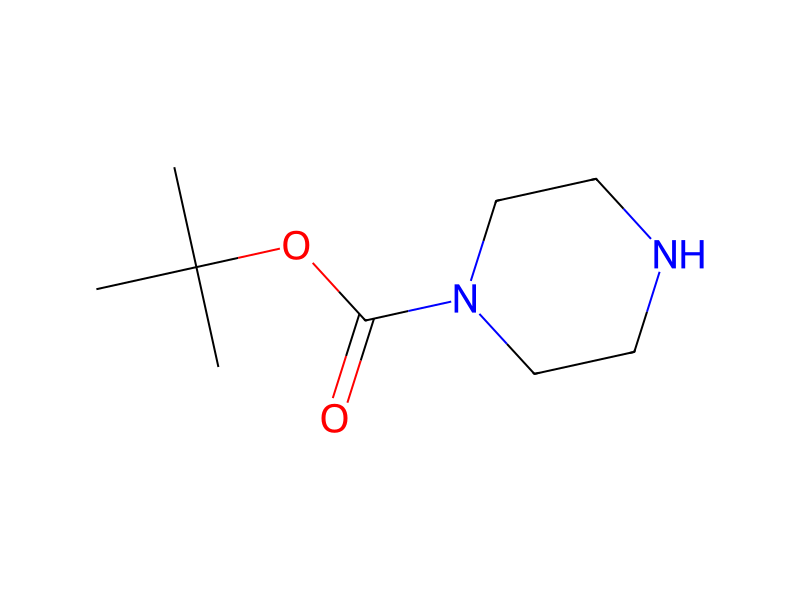
Cl[C:2]1[N:7]=[CH:6][N:5]=[C:4]2[NH:8][N:9]=[CH:10][C:3]=12.[C:11]([O:15][C:16]([N:18]1[CH2:23][CH2:22][NH:21][CH2:20][CH2:19]1)=[O:17])([CH3:14])([CH3:13])[CH3:12].C(N(C(C)C)CC)(C)C.C([O-])(O)=O.[Na+]>CN1C(=O)CCC1.C(OCC)(=O)C>[C:11]([O:15][C:16]([N:18]1[CH2:23][CH2:22][N:21]([C:2]2[N:7]=[CH:6][N:5]=[C:4]3[NH:8][N:9]=[CH:10][C:3]=23)[CH2:20][CH2:19]1)=[O:17])([CH3:14])([CH3:12])[CH3:13]The 4-chloro-1H-pyrazolo[3,4-d]pyrimidine (500 mg, 3.24 mmol) and piperazine-1-carboxylic acid tert-butyl ester (603 mg, 3.24 mmol) were dissolved in 11.0 mL of NMP then treated with diisopropylethyl amine (845 μL, 4.85 mmol). The yellow solution was heated to 80 C overnight to completion and was allowed to cool to room temperature. The solution was diluted with ethyl acetate, poured into diluted NaHCO3 solution, and extracted with ethyl acetate. The combined organic was washed with water, brine, separated, dried over MgSO4, filtered, and concentrated in vacuo to afford the crude material as a tan solid. The material was triturated with DCM/hexanes to afford the 4-(1H-pyrazolo[3,4-d]pyrimidin-4-yl)-piperazine-1-carboxylic acid tert-butyl ester as a cream-colored solid (824 mg, 84%). 1H NMR (CDCl3, 400 MHz) δ 8.48 (s, 1H), 8.06 (s, 1H), 4.05 (m, 4H), 3.67 (m, 4H). LCMS (APCI+) m/z 305 [M+H]+; Rt=2.14 min.