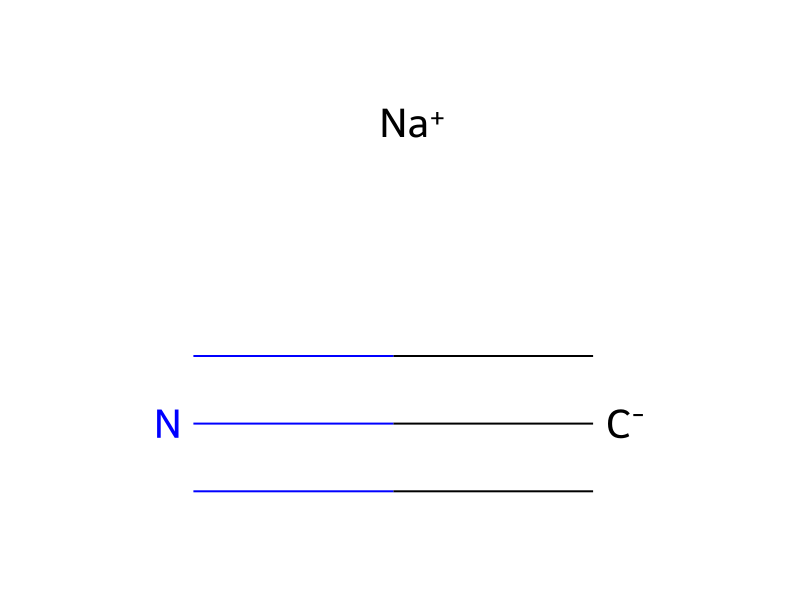
Sodium Cyanide → 2-Cyanophenylacetic acid
Reaktionsgleichung

[N+]([C:4]1[CH:9]=[CH:8][CH:7]=[CH:6][C:5]=1[CH2:10][C:11]([OH:13])=[O:12])([O-])=O.[C-:14]#[N:15].[Na+]>[Pd].[OH-].[Na+]>[C:14]([C:4]1[CH:9]=[CH:8][CH:7]=[CH:6][C:5]=1[CH2:10][C:11]([OH:13])=[O:12])#[N:15]Komponenten
5
Edukt 2

Produkt 1

Reagenzien, Katalysatoren, Lösungsmittel 2


Versuchsvorschrift
2-Nitrophenylacetic acid (ex Aldrich) (18.1 g) dissolved in 0.1M.aq.sodium hydroxide (100 ml) was subjected to catalytic hydrogenation (at 30-40 psi) over 10% palladium on charcoal (2 g) until uptake ceased. The resultant solution was subjected first to diazotisation and then reaction with sodium cyanide and cuprous cyanide according to Simchen and Hafner, Ann. Chem., 1974, 1802 to give crude 2-cyanophenylacetic acid (14.9 g). The latter was treated with phosphorous pentachloride (20.6 g) and anhydrous hydrogen chloride in di-n-butyl ether (250 ml) for 2 hours. After a further 18 hours the volatiles were removed, the residue washed with water and recrystallized from ethanol to give 1-chloro-3-hydroxy-isoquinoline (1.48 g).
Quellen und Nachweise
- ORD-Eintrag
- ord-9c46674a505443329b8f608854c3f72f
- Quelldatensatz
- uspto-grants-1992_05
- Patentnummer
- US05114940
Notizen zur Reaktion
Wird geladen…