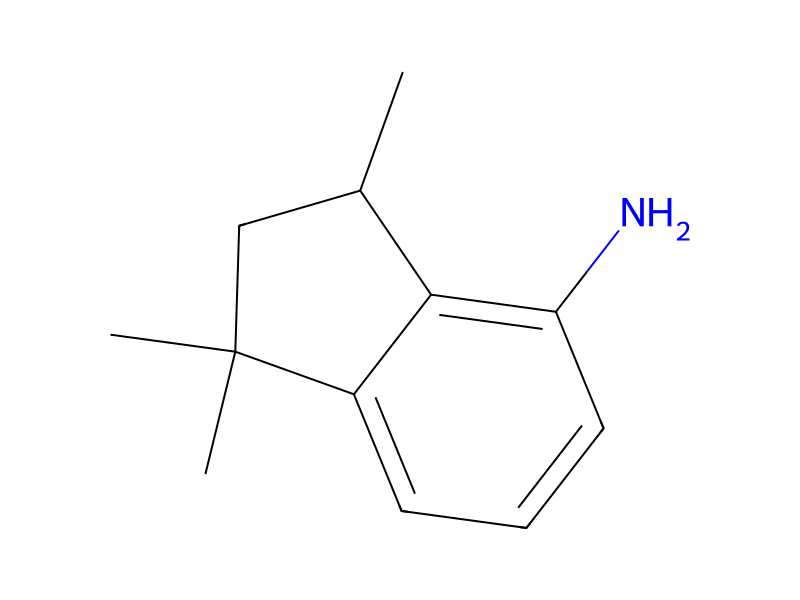
[CH3:1][C:2]1([CH3:13])[C:10]2[C:5](=[C:6]([NH2:11])[CH:7]=[CH:8][CH:9]=2)[CH:4]([CH3:12])[CH2:3]1.C(N(CC)CC)C.[CH3:21][N:22]1[C:26]([CH3:27])=[C:25]([C:28](Cl)=[O:29])[C:24]([CH3:31])=[N:23]1.O>O1CCCC1>[CH3:21][N:22]1[C:26]([CH3:27])=[C:25]([C:28]([NH:11][C:6]2[CH:7]=[CH:8][CH:9]=[C:10]3[C:5]=2[CH:4]([CH3:12])[CH2:3][C:2]3([CH3:13])[CH3:1])=[O:29])[C:24]([CH3:31])=[N:23]1To a solution of 1.75 g of 1,1,3-trimethyl-4-aminoindane and 2 ml of triethylamine in 50 ml of tetrahydrofuran was with stirring at room temperature added dropwise a solution of 1.73 g of 1,3,5-trimethylpyrazole-4-carboxylic acid chloride in 10 ml of tetrahydrofuran, followed by stirring at room temperature for 12 hours. Then, the reaction solution was poured into a cold water to result in separation into two layers. The aqueous layer was extracted with ethyl acetate and the organic layer was dried over anhydrous magnesium sulfate and the solvent was distilled off. The residue was recrystallized with toluene to obtain 2.55 g of 1,3,5-trimethyl-N-(1,1,3-trimethylindane-4-yl)pyrazole-4-carboxamide (mp 176.2° C.).
Wird geladen…