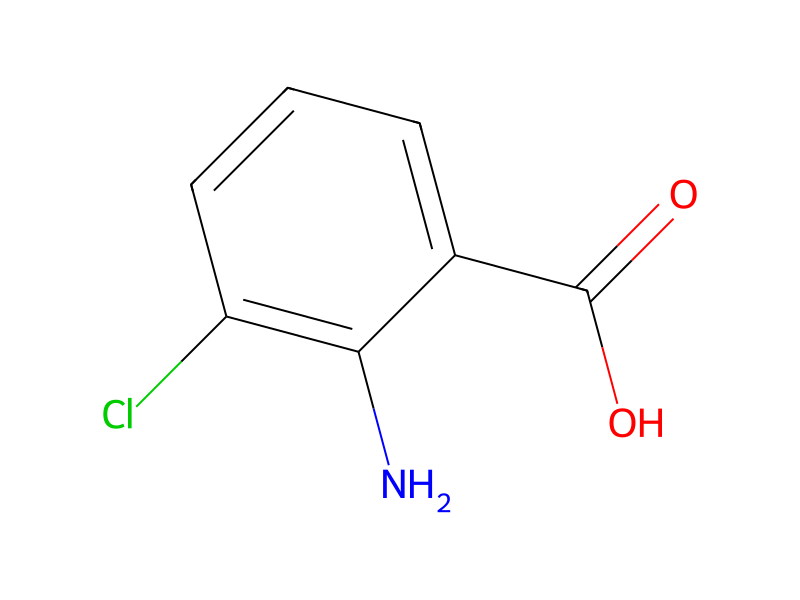
[NH2:1][C:2]1[C:10]([Cl:11])=[CH:9][CH:8]=[CH:7][C:3]=1[C:4]([OH:6])=O.Cl[CH2:13][CH2:14][CH2:15][N:16]=[C:17]=[O:18]>O>[Cl:11][C:10]1[CH:9]=[CH:8][CH:7]=[C:3]2[C:2]=1[N:1]=[C:17]1[N:16]([CH2:15][CH2:14][CH2:13][O:18]1)[C:4]2=[O:6]A 250 mL round bottom flask is charged with 2-amino-3-chlorobenzoic acid (5.00 g, 29.1 mmol) and 40 mL of 10% aqueous KHCO3. The slurry is cooled to 0° C., and 3-chloropropylisocyanate (5.25 mL, 51.2 mmol) is added. The reaction mixture is allowed to warm to room temperature over 3 hours, warmed to reflux for 2 hours, then stirred at room temperature for 16 hours. It is then diluted with 40 mL H2O and cooled to 0° C. The product is collected by filtration to provide 5.68 g of a yellow solid. This material is purified by recrystallization: it is dissolved in a minimal volume of warm CH2Cl2 (ca. 10 mL), cooled to 0° C., and IPE (ca. 20 mL) added to the point of cloudiness; crystallization is allowed to proceed at that temperature for 1 hour. The resulting yellow solid is collected and dried to provide 3.87 g (16.3 mmol, 56% yield) of light yellow solid.