Hydrazoic acid → 5-(3-Chloropropyl)-1-cyclohexyltetrazole
Reaktionsgleichung

[Cl:1][CH2:2][CH2:3][CH2:4][C:5]([NH:7][CH:8]1[CH2:13][CH2:12][CH2:11][CH2:10][CH2:9]1)=O.P(Cl)(Cl)(Cl)(Cl)Cl.[NH:20]=[N+:21]=[N-:22]>C1C=CC=CC=1>[CH:8]1([N:7]2[C:5]([CH2:4][CH2:3][CH2:2][Cl:1])=[N:22][N:21]=[N:20]2)[CH2:13][CH2:12][CH2:11][CH2:10][CH2:9]1Komponenten
5
Edukt 3
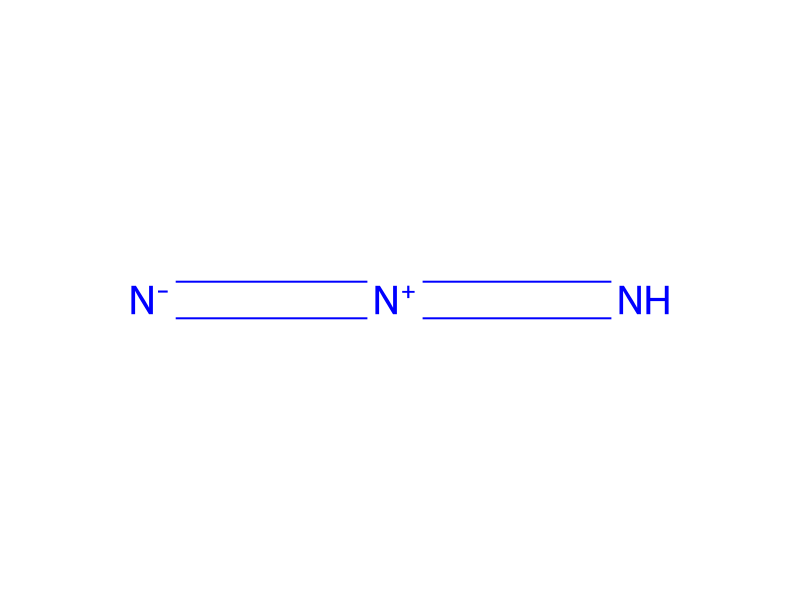


Produkt 1

Reagenzien, Katalysatoren, Lösungsmittel 1

Versuchsvorschrift
Into 200 ml of dried benzene, 30.6 g of N-γ-chlorobutyrylcyclohexylamine was added. While the inside temperature is kept below 20° C. by ice-cooling the outside of the reaction vessel, 30 g of PCl5 was added under stirring condition. After completion of the addition, the stirring is continued for 2 hours at a room temperature, then the reaction mixture is concentrated to a half volume thereof by using an evaporator with a bath temperature of below 50° C. To the concentrated reaction mixture was added dropwise 140 ml of benzene containing 10% of HN3 under stirring condition for 90 minutes while keeping the inside temperature below 15° C. After the addition operation, the reaction mixture is allowed to stand overnight at room temperature. Then the reaction mixture is refluxed for 3 hours with stirring and is concentrated. The thus obtained concentrate is extracted with 200 ml of chloroform. The chloroform layer is washed with 5% NaHCO3 aqueous solution and with water and dried with Na2SO4. After removal of the drying agent, the mother liquor is concentrated and the residue thus obtained is recrystallized from water-containing isopropanol to obtain 28 g of 1-cyclohexyl-5-γ-chloropropyltetrazole in the form of colorless needle like crystals. Melting point: 82°-85° C.