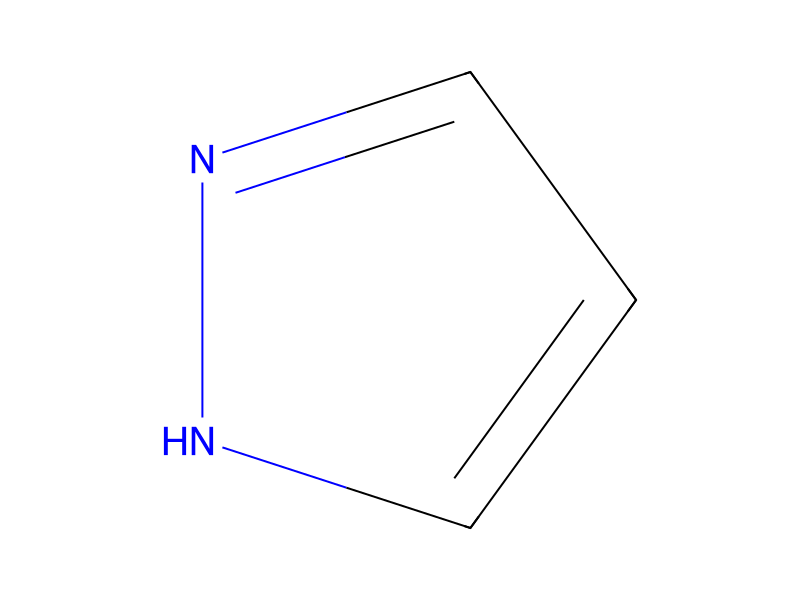
[H-].[Na+].[NH:3]1[CH:7]=[CH:6][CH:5]=[N:4]1.[CH2:8]([O:10][C:11]([C:13]1[CH:14]=[N:15][N:16]([CH3:19])[C:17]=1Cl)=[O:12])[CH3:9].O>CN(C=O)C.C(OCC)(=O)C>[CH2:8]([O:10][C:11]([C:13]1[CH:14]=[N:15][N:16]([CH3:19])[C:17]=1[N:3]1[CH:7]=[CH:6][CH:5]=[N:4]1)=[O:12])[CH3:9]Sodium hydride (60% in oil; 767 mg, 19 mmol) was added to a solution of pyrazole (1.36 g, 20 mmol) in dry DMF (40 mL) under nitrogen at 0° C. in an ice-water bath and the mixture was heated to 40° C. for 1 h. 5-Chloro-1-methyl-1H-pyrazole-4-carboxylic acid ethyl ester (1.89 g, 10 mmol) was added and the mixture was heated to 100° C. overnight and then cooled. Water and ethyl acetate were added, the organic layer was separated, and the aqueous phase was extracted three times with EtOAc. The combined organic phases were concentrated in vacuo and the residue was purified by flash silica chromatography eluting with a gradient of 0-20% ethyl acetate/hexanes, then 20% ethyl acetate/hexanes to give 2′-methyl-2′H-[1,3′]bipyrazolyl-4′-carboxylic acid ethyl ester (0.2 g, 9%).