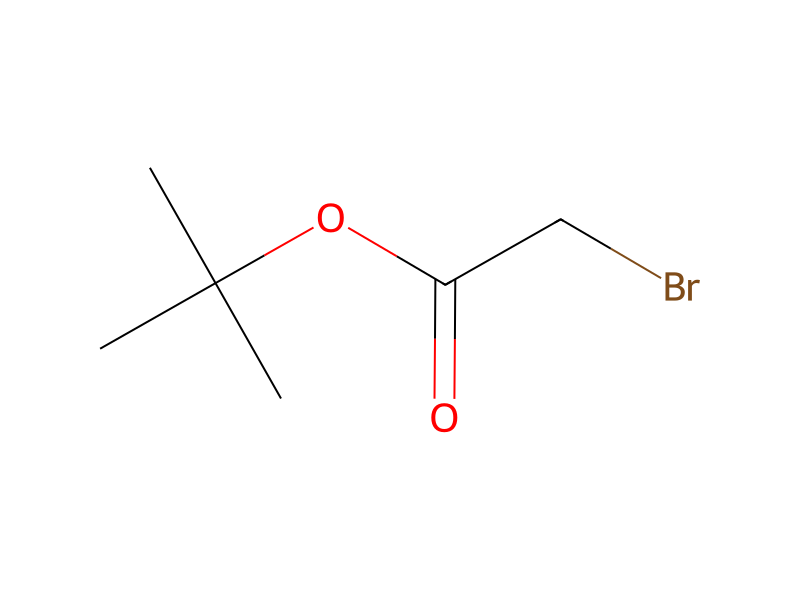
N-hydroxyphthalimide (3.87 g, 23 mmol) and potassium carbonate (2.14 g, 15.5 mmol) were suspended in 1-methyl-2-pyrrolidinone (23 mL) and heated to 40° C. t-Butyl-bromoacetate (4.58 g, 23 mmol) was added, and the reaction temperature was increased to 50° C., and held at this temperature for 4 hours, and then poured into 50 mL of ice water to precipitate the product. The solid was collected on a glass filter funnel and washed with water until the filtrate was colorless. The precipitate was dried on the filter funnel with the house vacuum, and by azeotroping with chloroform. This afforded 5.92 g (91% yield) of product with a melting point of 143-144° C. The compound was characterized as NMR and MS as follows: 1) C-NMR (CDCl3): 28.39, 73.82, 83.38, 124.04, 129.22, 134.99, 163.40, 166.29 ppm; 2) H-NMR (CDCl3): 1.46 (s, 9H); 4.68 (s, 2H); 7.74 (m, 2H); 7.83 (m, 2H) ppm; and 3) MS (ESI): 300.2 [M+Na]+, 577.3 [2M+Na]+.