StartseiteMCPWorkbenchSkills
StartseiteWorkbenchBenachrichtigungenMein Bereich
llms.txt · MCP-AnleitungDatenschutz · Nutzungsbedingungen · Supportv1.8.3
  1. Startseite
  2. /Reaktion

Triphenylphosphine → 1-[3-(4-Bromo-2-methyl-2H-pyrazol-3-yl)-4-(2-pyridin-4-yl-ethoxy)-phenyl]-3-(4-chloro-phenyl)-urea

HRID 1362991
Drucken

Reaktionsgleichung

Reaktionsgleichung von HRID 1362991
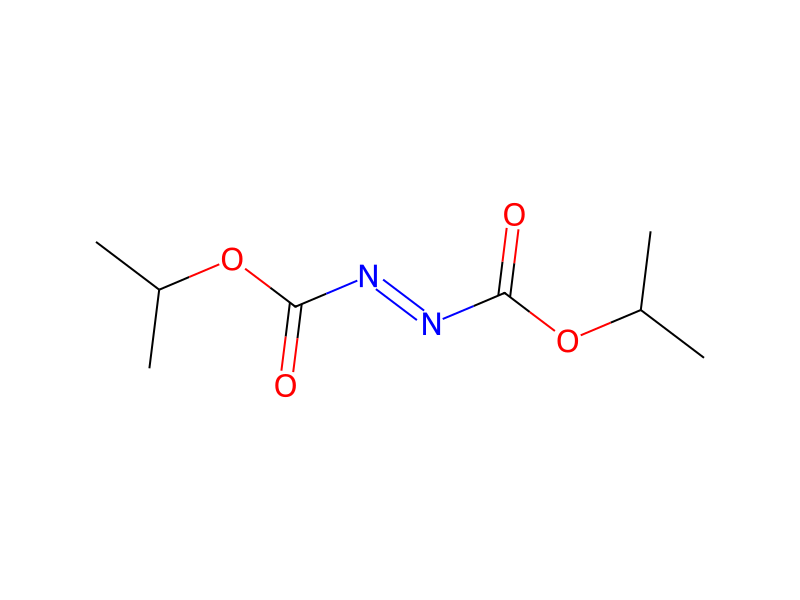
[Br:1][C:2]1[CH:6]=[N:5][N:4]([CH3:7])[C:3]=1[C:8]1[CH:9]=[C:10]([NH:15][C:16]([NH:18][C:19]2[CH:24]=[CH:23][C:22]([Cl:25])=[CH:21][CH:20]=2)=[O:17])[CH:11]=[CH:12][C:13]=1[OH:14].O[CH2:27][CH2:28][C:29]1[CH:34]=[CH:33][N:32]=[CH:31][CH:30]=1.C1(P(C2C=CC=CC=2)C2C=CC=CC=2)C=CC=CC=1.CC(OC(/N=N/C(OC(C)C)=O)=O)C>C1COCC1>[Br:1][C:2]1[CH:6]=[N:5][N:4]([CH3:7])[C:3]=1[C:8]1[CH:9]=[C:10]([NH:15][C:16]([NH:18][C:19]2[CH:20]=[CH:21][C:22]([Cl:25])=[CH:23][CH:24]=2)=[O:17])[CH:11]=[CH:12][C:13]=1[O:14][CH2:27][CH2:28][C:29]1[CH:34]=[CH:33][N:32]=[CH:31][CH:30]=1
KomponentenVersuchsvorschriftAufarbeitungQuellen und NachweiseNotizen zur Reaktion

Komponenten

6

Edukt 4

HCID 11776Triphenylphosphine2×HCID 729214-Pyridineethanol2×HCID 5363146Diisopropyl azodicarboxylateHCID 1355074951-(3-(4-bromo-1-methyl-1H-pyrazol-5-yl)-4-hydroxyphenyl)-3-(4-chlorophenyl)urea

Produkt 1

HCID 115482181-[3-(4-Bromo-2-methyl-2H-pyrazol-3-yl)-4-(2-pyridin-4-yl-ethoxy)-phenyl]-3-(4-chloro-phenyl)-urea
Ausbeute 44 %

Reagenzien, Katalysatoren, Lösungsmittel 1

HCID 8028TetrahydrofuranLösungsmittel

Versuchsvorschrift

To a solution of 1-[3-(4-bromo-2-methyl-2H-pyrazol-3-yl)-4-hydroxy-phenyl]-3-(4-chloro-phenyl)-urea (0.1 g, 0.24 mmol), 4-(2-hydroxyethyl)-pyridine (0.0443 g, 0.36 mmol), and triphenylphosphine (0.0944 g, 0.36 mmol) in 10 mL of dry THF was added diisopropylazo-dicarboxylate (0.0728 g, 0.36 mmol) at ambient temperature. The mixture was stirred for 2 hours. Next, additional triphenylphosphine (0.0944 g, 0.36 mmol), 4-(2-hydroxyethyl)-pyridine (0.0443 g, 0.36 mmol), and diisopropylazodicarboxylate were added and the reaction mixture further stirred at room temperature overnight. The solvent from the reaction mixture was evaporated and the crude residue was dissolved in 5.0 mL of DMSO and purified by RP-HPLC. The proper fractions were collected and concentrated to ¼ volume. The aqueous solution was neutralized with 1N NaOH and extracted with ethyl acetate (2×, 59 mL). The organic layer was dried with sodium sulfate, filtered and evaporated to dryness to afford 1-[3-(4-Bromo-2-methyl-2H-pyrazol-3-yl)-4-(2-pyridin-4-yl-ethoxy)-phenyl]-3-(4-chloro-phenyl)-urea as a brown solid in 44% yield. LCMS m/z (%)=526 (M+H 79Br, 100), 528 (M+H 81Br, 67). 1H NMR (DMSO-d6) δ: 9.33 (bs, 1H), 9.24 (bs, 1H), 8.39 (dd, J=4.44 and 1.48 Hz, 2H), 7.63 (d, J=7.28 Hz, 1H), 7.59 (s, 1H), 7.56 (dd, J=8.94 and 2.71 Hz, 2H), 7.48 (m, 1H), 7.34 (d, J=2.67, 1H), 7.31 (d, J=2.67, 1H), 7.28 (dd, J=6.88 and 4.87 Hz, 2H), 7.14 (d, J=9.05 Hz, 1H), 7.09 (d, J=5.93 Hz, 1H), 4.01-4.2 (m, 2H), 3.48 (s, 3H), 2.96-2.91 (m, 2H).


Aufarbeitung

  1. stirringthe reaction mixture further stirred at room temperature overnight
  2. customThe solvent from the reaction mixture was evaporated
  3. dissolutionthe crude residue was dissolved in 5.0 mL of DMSO
  4. custompurified by RP-HPLC
  5. customThe proper fractions were collected
  6. concentrationconcentrated
  7. extractionextracted with ethyl acetate (2×, 59 mL)
  8. dry with materialThe organic layer was dried with sodium sulfate
  9. filtrationfiltered
  10. customevaporated to dryness

Quellen und Nachweise

ORD-Eintrag
ord-ae2e2a15cfb44e3c8c0bddafaf4489b5
Quelldatensatz
uspto-grants-2011_02
DOI
10.6084/m9.figshare.5104873.v1
Patentnummer
US07884101B2

Notizen zur Reaktion

Auf dieser SeiteKomponentenVersuchsvorschriftAufarbeitungQuellen und NachweiseNotizen zur Reaktion