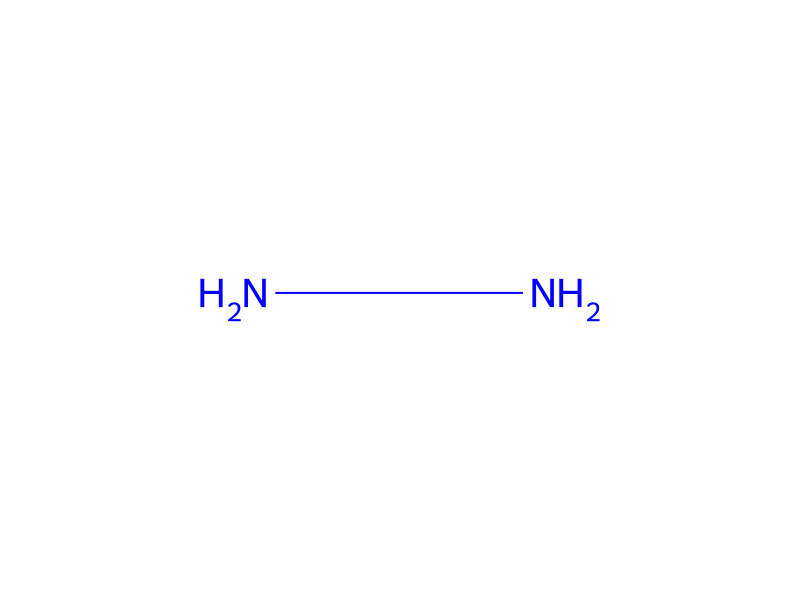
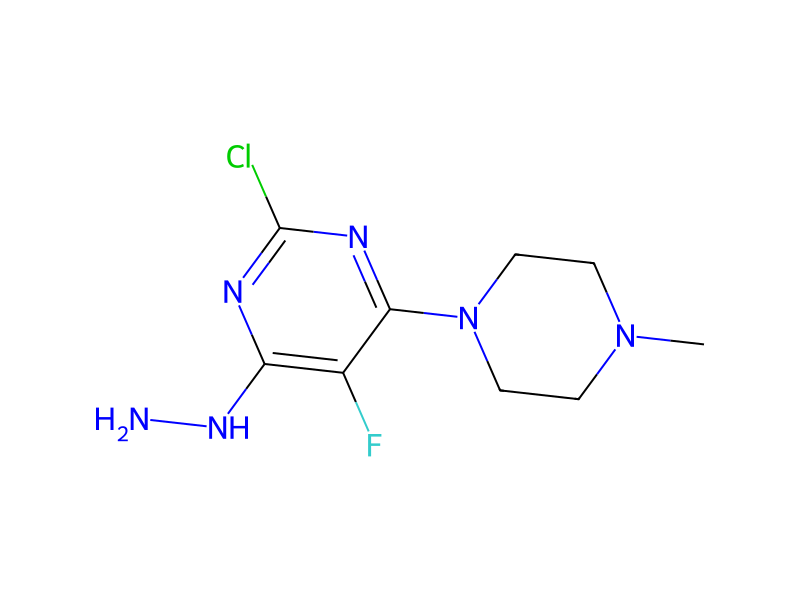
[Cl:1][C:2]1[N:7]=[C:6](Cl)[C:5]([F:9])=[C:4](Cl)[N:3]=1.CCN(C(C)C)C(C)C.[CH3:20][N:21]1[CH2:26][CH2:25][NH:24][CH2:23][CH2:22]1.[NH2:27][NH2:28]>CS(C)=O>[Cl:1][C:2]1[N:7]=[C:6]([NH:27][NH2:28])[C:5]([F:9])=[C:4]([N:24]2[CH2:25][CH2:26][N:21]([CH3:20])[CH2:22][CH2:23]2)[N:3]=1To a solution of 2,4,6-trichloro-5-fluoropyrimidine (402 mg, 2.0 mmol) in DMSO (3 mL) was added DIPEA (0.52 mL, 3.0 mmol), followed by N-methylpiperazine (0.24 mL, 2.2 mmol). The solution was stirred at room temperature. After 30 min, anhydrous hydrazine (1.29 mL, 99 mmol) was added, and the resulting mixture was heated at 80° C. for 30 min. After cooling to room temperature, the excess hydrazine was removed in vacuo, and the remaining solution was purified via RP-HPLC to provide the assumed 2-chloro-5-fluoro-4-hydrazino-6-(4-methyl-1-piperazinyl)pyrimidine (first eluent, 44 mg), as well as the assumed 6-chloro-5-fluoro-2-hydrazino-4-(4-methyl-1-piperazinyl)pyrimidine (second eluent, 30 mg). LCMS: (M+H)+: 261.1.