StartseiteMCPWorkbenchSkills
StartseiteWorkbenchBenachrichtigungenMein Bereich
llms.txt · MCP-AnleitungDatenschutz · Nutzungsbedingungen · Supportv1.8.0
  1. Startseite
  2. /Reaktion

3-(1,3-Benzodioxol-5-yl)prop-2-enoic acid → (S)-3-(3,4-Methylenedioxyphenyl)-prop-2-enoylproline benzyl ester

HRID 1377882
Notizen
Druckvorschau

Reaktionsgleichung

Reaktionsgleichung von HRID 1377882
[CH2:1]1[O:14][C:13]2[CH:12]=[CH:11][C:5]([CH:6]=[CH:7][C:8]([OH:10])=O)=[CH:4][C:3]=2[O:2]1.Cl.[CH2:16]([O:23][C:24](=[O:30])[C@@H:25]1[CH2:29][CH2:28][CH2:27][NH:26]1)[C:17]1[CH:22]=[CH:21][CH:20]=[CH:19][CH:18]=1.Cl.C(OC(=O)[C@H](C)N)C1C=CC=CC=1.C(N(C(C)C)CC)(C)C.F[P-](F)(F)(F)(F)F.N1(O[P+](N(C)C)(N(C)C)N(C)C)C2C=CC=CC=2N=N1>C(#N)C>[CH2:16]([O:23][C:24](=[O:30])[C@@H:25]1[CH2:29][CH2:28][CH2:27][N:26]1[C:8](=[O:10])[CH:7]=[CH:6][C:5]1[CH:11]=[CH:12][C:13]2[O:14][CH2:1][O:2][C:3]=2[CH:4]=1)[C:17]1[CH:18]=[CH:19][CH:20]=[CH:21][CH:22]=1
KomponentenVersuchsvorschriftAufarbeitungQuellen und NachweiseNotizen zur Reaktion

Komponenten

7

Edukt 5

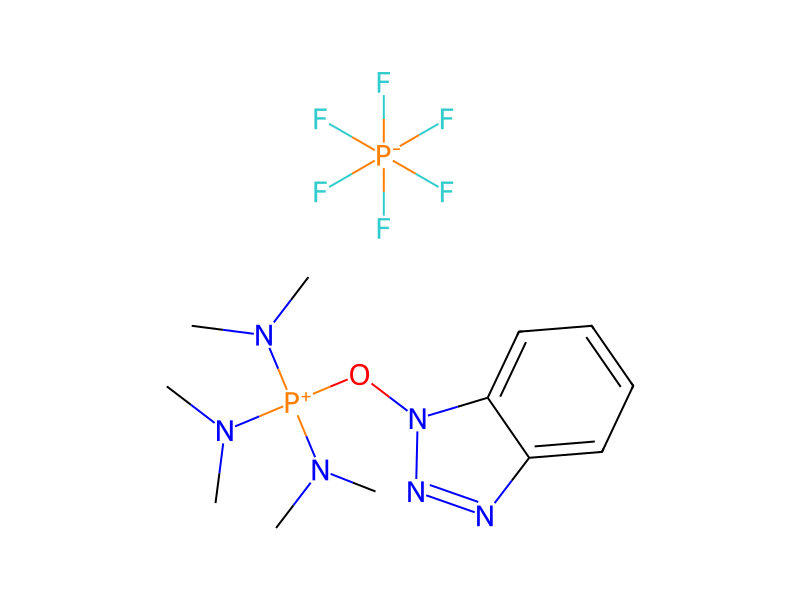
HCID 169173-(1,3-Benzodioxol-5-yl)prop-2-enoic acidHCID 81531DiisopropylethylamineHCID 151348Benzotriazol-1-yloxy-tris(dimethylamino)phosphonium hexafluorophosphateHCID 2733413Proline benzyl ester hydrochlorideHCID 12210893L-Alanine, phenylmethyl ester, hydrochloride (1:1)

Produkt 1

HCID 54124183
(S)-3-(3,4-Methylenedioxyphenyl)-prop-2-enoylproline benzyl ester
Ausbeute 74,9 %

Reagenzien, Katalysatoren, Lösungsmittel 1

HCID 6342AcetonitrileLösungsmittel

Versuchsvorschrift

A solution of 192 mg (1.0 mmol) of 3,4-methylenedioxycinnamic acid, 121 mg (0.5 mmol) of proline benzyl ester hydrochloride and 108 mg (0.5 mmol) of alanine benzyl ester hydrochloride in 6 mL of acetonitrile was treated sequentially with 0.35 mL (2.0 mmol) of diisopropylethylamine and 443 mg (1.0 mmol) of benzotriazol-1-yloxytris(dimethylamino)phosphonium hexafluorophosphate. The mixture was stirred for 16 hrs then concentrated in vacuo. The residue was dissolved in 10 mL of dichloromethane and poured into 3 volumes of diethyl ether. The mixture was washed sequentially with water, 10% potassium bisulfate solution, water, saturated sodium bicarbonate solution, water and saturated sodium chloride solution. The organic layer was dried over magnesium sulfate, filtered and concentrated in vacuo. The residue was purified by silica gel column chromatography, using a stepwise gradient of 30%, 35%, 40%, and 45% ethyl acetate in hexane as eluant. Ester (9) (142 mg) was obtained as a colorless oil, Rf=0.4 (40% ethyl acetate/hexane); HPLC, Rt 12.26; 1H NMR (300 MHz) consistent with structure. Ester (10) (162 mg) was obtained as a colorless oil; TLC, Rf =0.22 (40% ethyl acetate/hexane); HPLC, Rt 11.84 min; 1H NMR (300 MHz) consistent with structure.

Aufarbeitung

  1. concentrationthen concentrated in vacuo
  2. dissolutionThe residue was dissolved in 10 mL of dichloromethane
  3. additionpoured into 3 volumes of diethyl ether
  4. washThe mixture was washed sequentially with water, 10% potassium bisulfate solution, water, saturated sodium bicarbonate solution, water and saturated sodium chloride solution
  5. dry with materialThe organic layer was dried over magnesium sulfate
  6. filtrationfiltered
  7. concentrationconcentrated in vacuo
  8. customThe residue was purified by silica gel column chromatography

Quellen und Nachweise

ORD-Eintrag
ord-9db45696506b4828a64ff6f7e96486d1
Quelldatensatz
uspto-grants-1997_09
DOI
10.6084/m9.figshare.5104873.v1
Patentnummer
US05665774

Notizen zur Reaktion

Wird geladen…

Auf dieser SeiteKomponentenVersuchsvorschriftAufarbeitungQuellen und NachweiseNotizen zur Reaktion