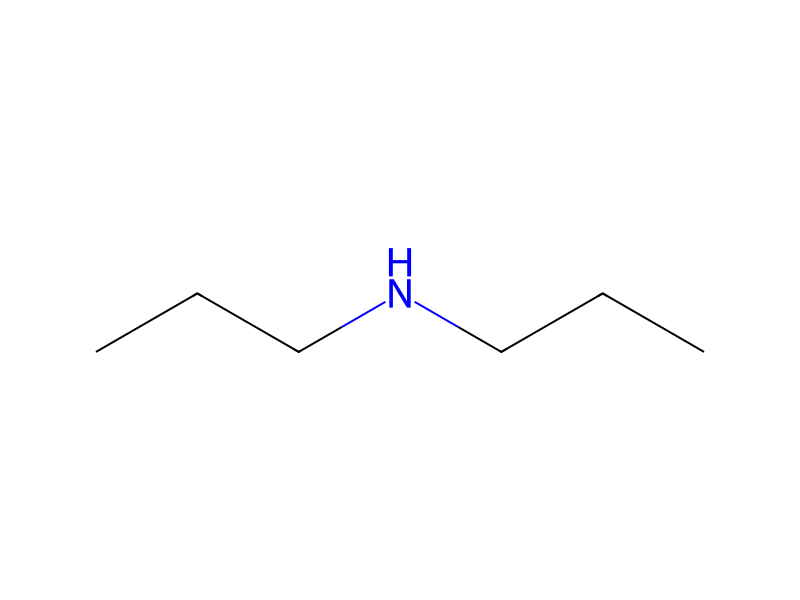
Dipropylamine → 2-(2-Methyl-3-nitrophenyl)-N,N-dipropylacetamide
HRID 1436850
Reaktionsgleichung

[CH3:1][C:2]1[C:7]([N+:8]([O-:10])=[O:9])=[CH:6][CH:5]=[CH:4][C:3]=1[CH2:11][C:12]([OH:14])=O.S(Cl)(Cl)=O.CC1C([N+]([O-])=O)=CC=CC=1CC(Cl)=O.[CH2:33]([NH:36][CH2:37][CH2:38][CH3:39])[CH2:34][CH3:35]>>[CH3:1][C:2]1[C:7]([N+:8]([O-:10])=[O:9])=[CH:6][CH:5]=[CH:4][C:3]=1[CH2:11][C:12]([N:36]([CH2:37][CH2:38][CH3:39])[CH2:33][CH2:34][CH3:35])=[O:14]Komponenten
5



Versuchsvorschrift
The process as shown above comprises conversion of 2-methyl-3-nitro phenyl acetic acid (II) with thionyl chloride to 2-Methyl-3-nitro-phenylacetyl chloride (III), which upon reaction with Di-n-propyl amine (DPA) gives 2-Methyl-3-nitro phenyl-N,N-di-n-propyl acetamide (IV) in syrup form. This intermediate (IV) is further reduced with Borane/THF and subsequent treatment with HCl/NaOH to give 2-Methyl-3-nitro phenyl ethyl-N,N-di-n-propyl amine (V). Further, compound (V) is treated with Na metal, Ethanol and diethyl oxalate to obtain Ethyl 6-(2-di-n-propylaminoethyl)-2-nitrophenyl pyruvate (VI), which is further treated with hydrogen peroxide , NaOH and HCl and converted to 6-(2-Di-n-propylaminoethyl)-2-nitro phenyl acetic acid hydrochloride (VII). This intermediate is reduced with palladium/carbon to give Ropinirole hydrochloride (Ia).