Imidazole-4-carboxaldehyde → Triphenylphosphine Oxide
HRID 1446805
Reaktionsgleichung

[C:1]1([P:7]([C:20]2[CH:25]=[CH:24][CH:23]=[CH:22][CH:21]=2)([C:14]2[CH:19]=[CH:18][CH:17]=[CH:16][CH:15]=2)=C(C)C(OC)=O)[CH:6]=[CH:5][CH:4]=[CH:3][CH:2]=1.N1C=C(C=[O:32])N=C1>C(O)C>[C:1]1([P:7](=[O:32])([C:20]2[CH:25]=[CH:24][CH:23]=[CH:22][CH:21]=2)[C:14]2[CH:19]=[CH:18][CH:17]=[CH:16][CH:15]=2)[CH:6]=[CH:5][CH:4]=[CH:3][CH:2]=1Komponenten
4
Edukt 2


Produkt 1
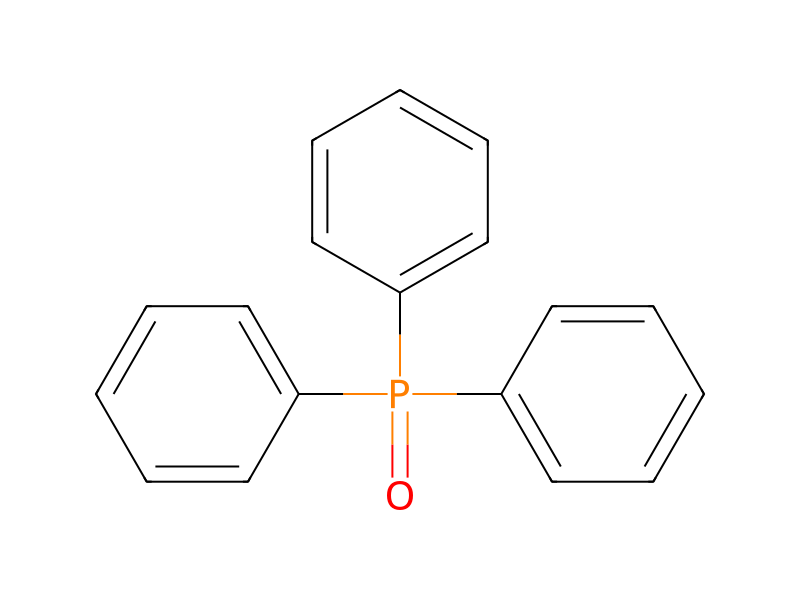
Reagenzien, Katalysatoren, Lösungsmittel 1

Versuchsvorschrift
A solution of 0.961 g (10 mmol) of methyl 2-(triphenylphosphoranylidene)propionate [H. J. Bestmann and H. Schulz, Angew. Chem., 73, 27 (1961)] and 3.48 g (10 mmol) of imidazole-4-carboxaldehyde [F. L. Pyman, J. Chem. Soc., 186 (1916)] in 50 ml of absolute ethanol is stirred at room temperature for seven days. At the end of this time, the ethanol is removed in vacuo and the desired product is isolated free of triphenylphosphine oxide by chromatography on silica gel. The product thus obtained is a mixture of E and Z olefin isomers.