StartseiteMCPWorkbenchSkills
StartseiteWorkbenchBenachrichtigungenMein Bereich
llms.txt · MCP-AnleitungDatenschutz · Nutzungsbedingungen · Supportv1.8.3
  1. Startseite
  2. /Reaktion

Hydrochloric Acid → Ethyl 3-(2,2-dibromovinyl)-2,2-dimethylcyclopropanecarboxylate

HRID 1449032
Drucken

Reaktionsgleichung

Reaktionsgleichung von HRID 1449032
Cl[C:2](Cl)=[CH:3][CH:4]1[CH:6]([C:7]([O:9][CH2:10][CH3:11])=[O:8])[C:5]1([CH3:13])[CH3:12].[Br-:15].[Al+3].[Br-:17].[Br-].N12CCCCC1C=NCCC2.Cl>C(Br)CBr.CCCCCC.CN(C)C=O.O>[Br:15][C:2]([Br:17])=[CH:3][CH:4]1[CH:6]([C:7]([O:9][CH2:10][CH3:11])=[O:8])[C:5]1([CH3:13])[CH3:12]
KomponentenVersuchsvorschriftAufarbeitungQuellen und NachweiseNotizen zur Reaktion

Komponenten

9

Edukt 4

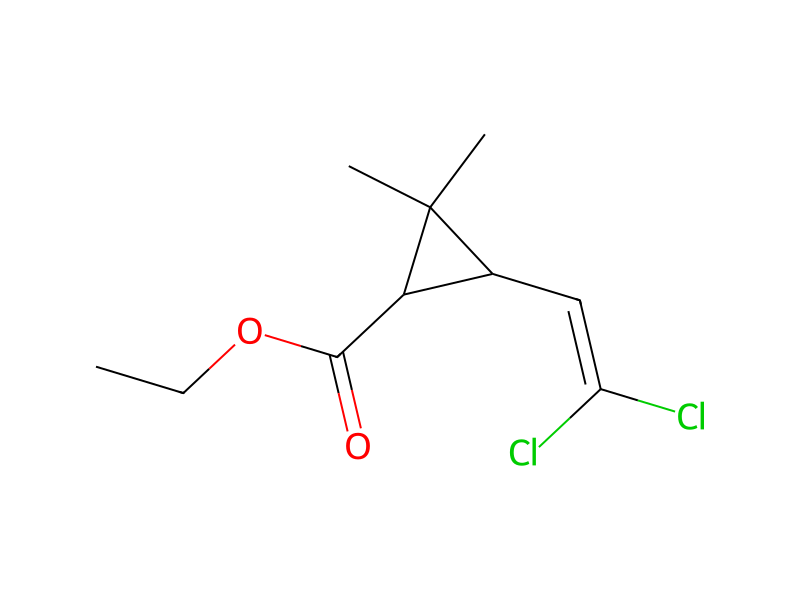
HCID 313Hydrochloric AcidHCID 101094Cyclopropanecarboxylic acid, 3-(2,2-dichloroethenyl)-2,2-dimethyl-, ethyl esterHCID 166749BromhydrolHCID 3141121,5-Diazabicyclo(5,4,0)undec-5-ene

Produkt 1

HCID 12550018Ethyl 3-(2,2-dibromovinyl)-2,2-dimethylcyclopropanecarboxylateAusbeute 87 %

Reagenzien, Katalysatoren, Lösungsmittel

4
HCID 962WaterLösungsmittelHCID 6228DimethylformamideLösungsmittelHCID 78391,2-DibromoethaneLösungsmittel2×HCID 8058HexaneLösungsmittel

Versuchsvorschrift

To a solution of ethyl 3-(2,2-dichlorovinyl)-2,2-dimethylcyclopropanecarboxylate (14.81 g, 0.0625 mole) in 30 ml of ethylene bromide was added dropwise at 0° a solution of aluminum bromide (25 g, 0.094 mole) in 20 ml of ethylene bromide. After stirring for 41/2 hours, the solution was poured into a mixture of ice and water. The resultant mixture was extracted three times with ether. The ether extracts were combined and successively washed twice with water, twice with aqueous sodium bicarbonate, twice with aqueous sodium chloride, and then dried over anhydrous magnesium sulfate. The ether was then removed by evaporation, leaving a residue. The residue was dissolved in n-hexane, and 1,5-diazabicyclo[5.4.0] undec-5-ene was added to the solution. Dimethylformamide was added as a cosolvent. The solution was poured into dilute aqueous hydrochloric acid at 0°. The resultant mixture was extracted with ether. The ether extract was washed with water, aqueous sodium bicarbonate, aqueous sodium chloride, and then dried. The ether was removed, and the residue was distilled under reduced pressure to afford ethyl 3-(2,2-dibromovinyl)-2,2-dimethylcyclopropanecarboxylate (16.28 g, 87% yield); bp, 104-106°/0.28 mm.


Aufarbeitung

  1. extractionThe resultant mixture was extracted three times with ether
  2. washsuccessively washed twice with water, twice with aqueous sodium bicarbonate, twice with aqueous sodium chloride
  3. dry with materialdried over anhydrous magnesium sulfate
  4. customThe ether was then removed by evaporation
  5. customleaving a residue
  6. extractionThe resultant mixture was extracted with ether
  7. extractionThe ether extract
  8. washwas washed with water, aqueous sodium bicarbonate, aqueous sodium chloride
  9. customdried
  10. customThe ether was removed
  11. distillationthe residue was distilled under reduced pressure

Quellen und Nachweise

ORD-Eintrag
ord-2b11926d964045fd8cab6ae00d8e6f25
Quelldatensatz
uspto-grants-1980_02
DOI
10.6084/m9.figshare.5104873.v1
Patentnummer
US04188492

Notizen zur Reaktion

Auf dieser SeiteKomponentenVersuchsvorschriftAufarbeitungQuellen und NachweiseNotizen zur Reaktion