Methyl p-toluenesulfonate → HCID 131719815, Verbindung
Reaktionsgleichung

[CH3:1][N:2]([CH2:4][CH2:5][CH2:6][CH2:7][CH2:8][C:9]([CH:11]1[CH2:18][CH2:17][CH2:16][CH2:15][NH:14][C:12]1=[O:13])=[O:10])[CH3:3].[C:19]1([CH3:30])[CH:24]=[CH:23][C:22]([S:25]([O:28]C)(=[O:27])=[O:26])=[CH:21][CH:20]=1.S([C:35]1C=CC(C)=CC=1)([O-])(=O)=O>C(#N)C>[C:19]1([CH3:30])[CH:20]=[CH:21][C:22]([S:25]([O-:28])(=[O:26])=[O:27])=[CH:23][CH:24]=1.[CH3:1][N+:2]([CH2:4][CH2:5][CH2:6][CH2:7][CH2:8][C:9]([CH:11]1[CH2:18][CH2:17][CH2:16][CH2:15][NH:14][C:12]1=[O:13])=[O:10])([CH3:35])[CH3:3]Komponenten
5
Edukt 3
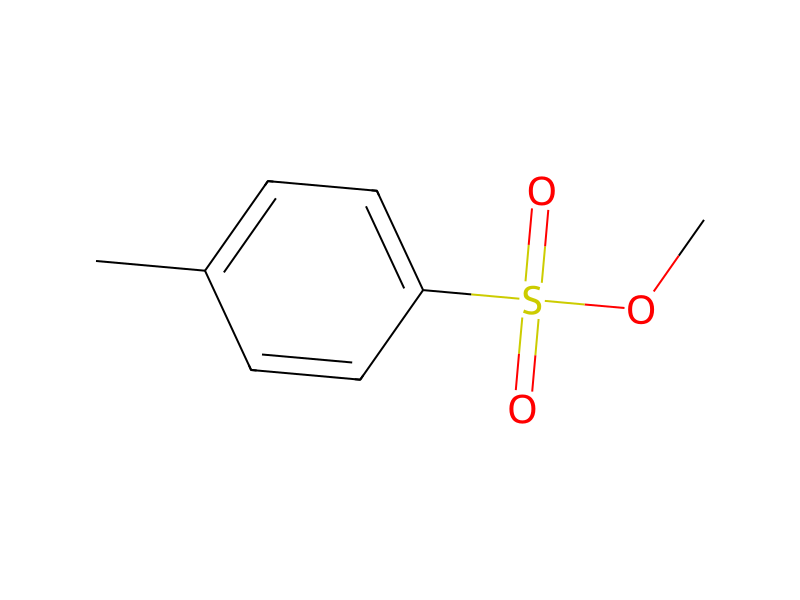


Produkt 1

Reagenzien, Katalysatoren, Lösungsmittel 1

Versuchsvorschrift
In a 500 mL three-necked round-bottomed flask fitted with an argon inlet, condenser, and stir bar are placed amine amide 4 (17.94 g, 0.071 mol), acetonitrile (200 mL), and methyl p-toluenesulfonate (13.13 g, 0.071 mol). While adding the tosylate, the reaction mixture mildly exotherms. The mixture is heated to reflux for 3 h and is then cooled to room temperature. While concentrating the mixture by rotary evaporation, a tan solid forms which is redissolved in a minimal amount of acetonitrile and triturated with ether until a free flowing dispersion of the solid is obtained in the solvent system. The solid is collected by vacuum filtration under a blanket of nitrogen and transferred to a round-bottomed flask. The solid product is a suitable cationic bleach activator. It is dried at room temperature under vacuum (0.1 mmHg) for 24 h to give 5 (Cationic Bleach Activator A) (27.84 g, 90%) as an off-white solid, mp 128°-131° C. (softens at 118° C.).