
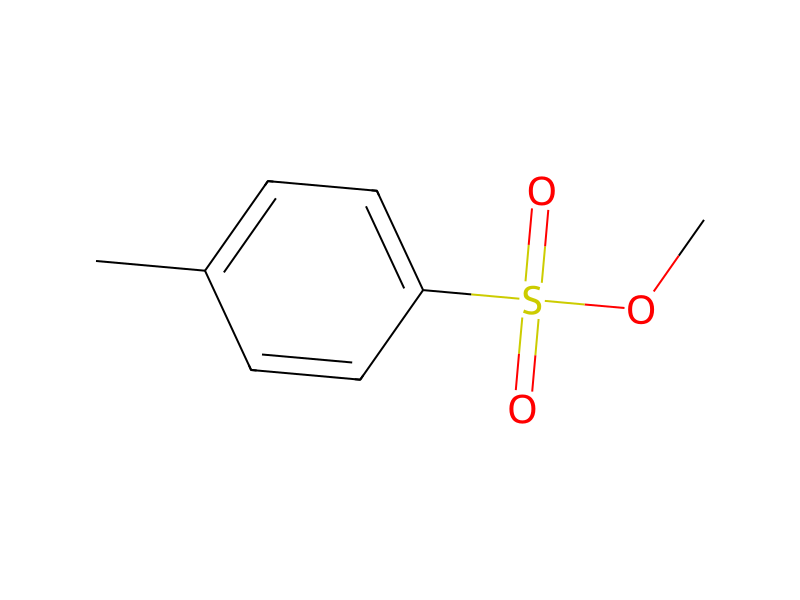
Grundinformationen
- Standard-SMILES
COS(=O)(=O)c1ccc(C)cc1- InChIKey
VUQUOGPMUUJORT-UHFFFAOYSA-N- Summenformel
- C8H10O3S
- Durchschnittliche Molmasse
- 186,23 g/mol
- Monoisotopische Masse
- 186,03506535
Namen und Bezeichner
- Bevorzugter Name
- Methyl p-toluenesulfonate
- IUPAC
- methyl 4-methylbenzenesulfonate
- Lokaler Name
- Methyltoluol-4-sulfonat
- Englischer Name
- Methyl p-toluenesulfonate
- Summenformel
- C8H10O3S
- Molmasse
- 186.23
Namen und Synonyme
Methyl p-toluenesulfonate80-48-8Methyl 4-methylbenzenesulfonateMethyl tosylateMethyl toluene-4-sulfonateMethyl-p-toluenesulfonateMethyl p-tosylateMethyl toluenesulfonateMethyl toluene-4-sulphonateBenzenesulfonic acid, 4-methyl-, methyl esterp-Toluenesulfonic acid, methyl esterMethyl toluene sulfonate
Weitere Namen anzeigen
MPTSPTSMEMETHYL 4-TOLUENESULFONATEMETHYL P-TOLUENESULPHONATEMethyl para-toluenesulfonate4-TOLUENESULFONIC ACID METHYL ESTER
p-Methylbenzenesulfonate methyl esterMETHYL P-METHYLBENZENESULFONATEp-Toluolsulfonsaeure methyl esterMethyl 4-toluene sulfonate4-Toluenesulfonic acid, methyl esterMethylester kyseliny p-toluensulfonoveDTXSID40525504SU69KI68L
Datenbank-Bezeichner
- CAS
80-48-8- PubChem CID
- 6645
- DTXSID
DTXSID4052550- ChEMBL
CHEMBL5189891- UNII
- 4SU69KI68L
- EC Number
- 201-283-5
- Nikkaji
- J54.424H
Eigenschaften
Berechnete Struktureigenschaften
- XLogP
- 2,2
- Polarare Oberfläche (TPSA)
- 51,8 Ų
- H-Brücken-Donoren
- 0
- H-Brücken-Akzeptoren
- 3
- Frei drehbare Bindungen
- 2
- Schwere Atome
- 12
- Formalladung
- 0
- Komplexität
- 219
Experimentelle und physikochemische Eigenschaften
Density
1.230 @ 25 DEG/25 °C
1.230-1.238 @25 °C
Color/Form
MONOCLINIC LEAFLETS OR PRISMS FROM ETHER-PETROLEUM ETHER
LIGHT BROWN CRYSTALS
WHITE DAMP CRYSTALS
SolubilityINSOL IN WATER; SLIGHTLY SOL IN PETROLEUM ETHER; SOL IN ETHER; VERY SOL IN ALCOHOL, BENZENE, CHLOROFORM
Flash Point306 °F (152 °C) (open cup)
Boiling Point292 °C @ 760 MM HG
Melting Point28-29 °C
Vapor Density6.45 (AIR= 1)
Physical Description
Liquid
White vesicant solid; Solidifies at 24 deg C; [Hawley] White or light brown solid; mp = 28-29 deg C; [HSDB] Off-white low melting solid or clear liquid; mp = 27-28 deg C; [MSDSonline]
Other Experimental Properties
LOW-MELTING SOLID OR LIQUID
DECOMP @ 262 °C
Physikochemische Eigenschaften
- Schmelzpunkt
- 25 · 25-28 °C(lit.)
- Siedepunkt
- 144 · 144-145 °C5 mm Hg(lit.)
- Dichte
- 1.234 g/mL · 1.234 g/mL at 25 °C(lit.)
- Dampfdichte
- 6.45 · 6.45 (vs air)
- Dampfdruck
- 1 mm · 1 mm Hg ( 20 °C)
- Brechungsindex
- 20 · n20/D 1.5172(lit.)
- Flammpunkt
- 230 °F · >230 °F
- storage temp.
- 2 · 2-8°C
- Löslichkeit
- Chloroform (Slightly), Methanol (Slightly)
- Aggregatzustand
- Liquid or Low Melting Solid
- Farbe
- White to yellow
- Wasserlöslichkeit
- Insoluble
- BRN
- 609209 · 609209
- InChI
- 1S/C8H10O3S/c1-7-3-5-8(6-4-7)12(9,10)11-2/h3-6H,1-2H3
- InChIKey
- VUQUOGPMUUJORT-UHFFFAOYSA-N
- SMILES
- COS(=O)(=O)c1ccc(C)cc1
- LogP
- 1.88 at · 1.88 at 25℃
- CAS Datenbank
- 80 · 80-48-8(CAS DataBase Reference)
- NIST chemische Informationen
- 4 · Benzenesulfonic acid, 4-methyl-, methyl ester(80-48-8)
- EPA chemische Informationen
- 4 · Benzenesulfonic acid, 4-methyl-, methyl ester (80-48-8)
Sicherheit und Regulatorisches
GHS-Klassifizierung
GHS Classification
Danger
H302 (100%): Harmful if swallowed [Warning Acute toxicity, oral];H311 (29.9%): Toxic in contact with skin [Danger Acute toxicity, dermal];H314 (22.8%): Causes severe skin burns and eye damage [Danger Skin corrosion/irritation];H315 (76.9%): Causes skin irritation [Warning Skin corrosion/irritation];H317 (97.2%): May cause an allergic skin reaction [Warning Sensitization, Skin];H319 (35%): Causes serious eye irritation [Warning Serious eye damage/eye irritation];H335 (26.2%): May cause respiratory irritation [Warning Specific target organ toxicity, single exposure; Respiratory tract irritation];H411 (29.6%): Toxic to aquatic life with long lasting effects [Hazardous to the aquatic environment, long-term hazard]
P260, P261, P262, P264, P264+P265, P270, P271, P272, P273, P280, P301+P317, P301+P330+P331, P302+P352, P302+P361+P354, P304+P340, P305+P351+P338, P305+P354+P338, P316, P319, P321, P330, P332+P317, P333+P317, P337+P317, P361+P364, P362+P364, P363, P391, P403+P233, P405, and P501 (click each P-code to see the statement)
Aggregated GHS information provided per 351 reports by companies from 26 notifications to the ECHA C&L Inventory. Each notification may be associated with multiple companies.;Information may vary between notifications depending on impurities, additives, and other factors. The percentage value in parenthesis indicates the notified classification ratio from companies that provide hazard codes. Only hazard codes with percentage values above 10% are shown. For more detailed information, please visit ECHA C&L website.
Gefahrenhinweise
Regulatory Information
Chemical: Benzenesulfonic acid, 4-methyl-, methyl ester
Benzenesulfonic acid, 4-methyl-, methyl ester is listed on the EPA's Chemical Data Reporting (CDR) system. Manufacturers and importers of Benzenesulfonic acid, 4-methyl-, methyl ester are required to report information about their production and use of this chemical to the EPA under the Toxic Substances Control Act (TSCA). (40 eCFR Part 711)
Status: Active Update: 22-02-2022 https://echa.europa.eu/registration-dossier/-/registered-dossier/21794;Status: Active Update: 11-12-2019 https://echa.europa.eu/registration-dossier/-/registered-dossier/18934
Methyl 4-toluenesulphonate: Does not have an individual approval but may be used under an appropriate group standard
Hazards Summary
A strong skin and eye irritant; [Hawley] Urticaria and skin sensitization have been reported; [HSDB] A corrosive substance that can cause injury to the skin, eyes, and respiratory tract; Inhalation may cause chemical pneumonitis; May cause skin sensitization; [MSDSonline]
NFPA Hazard Classification
2 - Materials that, under emergency conditions, can cause temporary incapacitation or residual injury.
1 - Materials that must be preheated before ignition can occur. Materials require considerable preheating, under all ambient temperature conditions, before ignition and combustion can occur.
0 - Materials that in themselves are normally stable, even under fire conditions.
Hazard Classes and Categories
Acute Tox. 4 (100%);Acute Tox. 3 (29.9%);Skin Corr. 1B (22.8%);Skin Irrit. 2 (76.9%);Skin Sens. 1B (97.2%);Eye Irrit. 2 (35%);STOT SE 3 (26.2%);Aquatic Chronic 2 (29.6%)
Skin corrosion/irritation - Category 2;Serious eye damage/eye irritation - Category 2
Skin corrosion/irritation - Category 1C;Serious eye damage/eye irritation - Category 1
Skin, Eye, and Respiratory IrritationsHIGHLY TOXIC BY INHALATION; STRONG IRRITANT TO SKIN & EYES.
Sicherheit und Schutzausrüstung
Fire Fighting ProceduresWATER OR FOAM MAY CAUSE FROTHING.
Cleanup Methods...DECONTAMINATION OF FLOORS & EQUIPMENT MAY BE EFFECTED BY FLUSHING WITH DILUTE ALKALI OR AMMONIA.
Disposal Methods
SRP: At the time of review, criteria for land treatment or burial (sanitary landfill) disposal practices are subject to significant revision. Prior to implementing land disposal of waste residue (including waste sludge), consult with environmental regulatory agencies for guidance on acceptable disposal practices.
Preventive Measures
SRP: The scientific literature for the use of contact lenses in industry is conflicting. The benefit or detrimental effects of wearing contact lenses depend not only upon the substance, but also on factors including the form of the substance, characteristics and duration of the exposure, the uses of other eye protection equipment, and the hygiene of the lenses. However, there may be individual substances whose irritating or corrosive properties are such that the wearing of contact lenses would be harmful to the eye. In those specific cases, contact lenses should not be worn. In any event, the usual eye protection equipment should be worn even when contact lenses are in place.
Protective Action Criteria (PAC)
1.0 [mg/m3]
11 [mg/m3]
68 [mg/m3]
Personal Protective Equipment (PPE)CONTAMINATED AREAS SHOULD BE ENTERED ONLY BY TRAINED PERSONNEL WITH IMPERVIOUS CLOTHING & AIR-SUPPLIED RESPIRATORS.
Toxikologische Informationen
Adverse EffectsDermatotoxin - Skin burns.;Skin Sensitizer - An agent that can induce an allergic reaction in the skin.;Toxic Pneumonitis - Inflammation of the lungs induced by inhalation of metal fumes or toxic gases and vapors.
Human Toxicity Excerpts
...CONTACT WITH SOLN OR SOLID MAY GIVE RISE TO NO SYMPTOMS FOR SEVERAL HR. ... /THEN/ THERE MAY BE...VESICATION AT SITE OF CONTACT, FREQUENTLY WITH LITTLE... PAIN. VERY LARGE BULLAE MAY BE FORMED... GENERALIZED TOXIC SYMPTOMS DO NOT SEEM TO OCCUR AND...BURNS HEAL USUALLY WITH SOME PIGMENTATION...
...THERE HAVE BEEN FEW INSTANCES OF PULMONARY IRRITATION. ...ONE INSTANCE WAS NOTED OF URTICARIAL REACTION FROM HEATED VAPOR; SKIN SENSITIZATION ALSO OCCURS.
...STRONG IRRITANT TO...EYES.
HIGHLY TOXIC BY INHALATION; STRONG IRRITANT TO SKIN & EYES.
Non-Human Toxicity Excerpts
BD RATS RECEIVING SC 15 WEEKLY X 53 MG/KG FOR 470 DAYS: 7/10 HAD LOCAL SARCOMA, 1 BRONCHIAL, 1 MAMMARY & 1 OVARIAN CARCINOMA. /FROM TABLE/
Several direct acting mutagens were tested for mutagenic activity in adult Drosophila melanogaster when administered in feeding or as an injected dose. An inhibitor or cytochrome p450, 1-phenylimidazole, administered at concentrations of 2.5, 4 and 10 mmol, was not mutagenic in Drosophila. Methyl-p-toluenesulfonate applied orally was a weak mutagen. When administered simultaneously with 1-phenylimidazole, a concentration dependent increase was noted in mutagenic activity of methyl-p-toluenesulfonate. Following injection, mutagenesis by methyl-p-toluenesulfonate was considerable. Ethyl-p-toluenesulfonate demonstrated marginal mutagenesis in Drosophila when orally applied but was decidedly mutagenic on injection. Simultaneous treatment with 4 mmol 1-phenylimidazole and 1 mmole of ethyl-p-toluenesulfonate did not alter mutagenesis nor did treatment with diethylmaleate (glutathione depletion). Combined treatment with 2 mmol ethyl-p-toluenesulfonate and 2 mmol 1-phenylimidazole produced a statistically significant increase in mutagenesis. /It was concluded/ that weak mutagenesis by p-toluenesulfonates after feeding experiments compared to considerable effects after injection suggests metabolic deactivation in the gut.
The carcinogenic activity of 12 direct alkylating substances was tested in 535 BD rats. Local sarcomas were produced by the subcutaneous injections once a week of p-toluene sulfonic acid methylester. Only a jew tumors were observed following treatment with p-toluene sulfonic acid ethylester and p-toluenesulfonic acid butylester were not carcinogenic.
Antidote and Emergency TreatmentFIRST AID TREATMENT: CONTACT...WITH SKIN OR EYES IS INDICATION FOR RAPID AND PROLONGED IRRIGATION OF AREA WITH LARGE VOL OF WATER.
Regulatorische Informationen
Regulatory Information
Chemical: Benzenesulfonic acid, 4-methyl-, methyl ester
Benzenesulfonic acid, 4-methyl-, methyl ester is listed on the EPA's Chemical Data Reporting (CDR) system. Manufacturers and importers of Benzenesulfonic acid, 4-methyl-, methyl ester are required to report information about their production and use of this chemical to the EPA under the Toxic Substances Control Act (TSCA). (40 eCFR Part 711)
Status: Active Update: 22-02-2022 https://echa.europa.eu/registration-dossier/-/registered-dossier/21794;Status: Active Update: 11-12-2019 https://echa.europa.eu/registration-dossier/-/registered-dossier/18934
Methyl 4-toluenesulphonate: Does not have an individual approval but may be used under an appropriate group standard
Sicherheitsdaten
- F
- 21
- wgk
- 3
- tsca
- TSCA listed
- ridadr
- UN 3261 8/PG 2
- hs_code
- 29051900
- RTECS-Nr.
- XT7000000
- risk_code
- 22-34-43-40-36/37/38
- Toxizität
- LD50 orally in Rabbit: 341 mg/kg
- hazard_code
- C,Xn
- safety_code
- 26-36/37/39-45-24
- hazard_class
- 8
- packing_group
- III
- Speicherklasse
- 8A - Combustible corrosive hazardous materials
- Giftige Stoffe Daten
- 80-48-8(Hazardous Substances Data)
- Hazard Classifications
- Acute Tox. 4 OralEye Dam. 1Skin Corr. 1BSkin Sens. 1B
- Selbstentzündungstemperatur
- 896 °F
Chemie und Industrie
Verwendung und Herstellung
Uses
Used as methylating agent in organic synthesis and as a catalyst for alkyd resins; [HSDB]
METHYLATING AGENT IN ORGANIC SYNTHESIS
ACCELERATOR; CATALYST FOR ALKYD RESINS
CHEM INT FOR BASIC DYE C.I. 46000
U.S. Imports
(1977) 1.35X10+7 GRAMS (PRINCPL CUSTMS DISTS)
(1979) 7.99X10+6 GRAMS (PRINCPL CUSTMS DISTS)
U.S. Production
2022: 119,181 lb;2021: 54,718 lb;2020: 31,482 lb
(1977) NOT PRODUCED COMMERCIALLY IN US
(1979) NOT PRODUCED COMMERCIALLY IN US
Industry UsesCorrosion inhibitor
Methods of ManufacturingPROBABLY BY REACTION OF P-TOLUENESULFONYL CHLORIDE WITH METHYL ALCOHOL
Formulations/PreparationsGRADE: 97% MIN
General Manufacturing Information
Fabricated Metal Product Manufacturing
Benzenesulfonic acid, 4-methyl-, methyl ester: ACTIVE
Anwendungen
VerwendenMethyl p-Toluenesulfonate can be used in the manufacture of dyes and organic synthesis, and also is the raw materials of methylation.
Darstellung
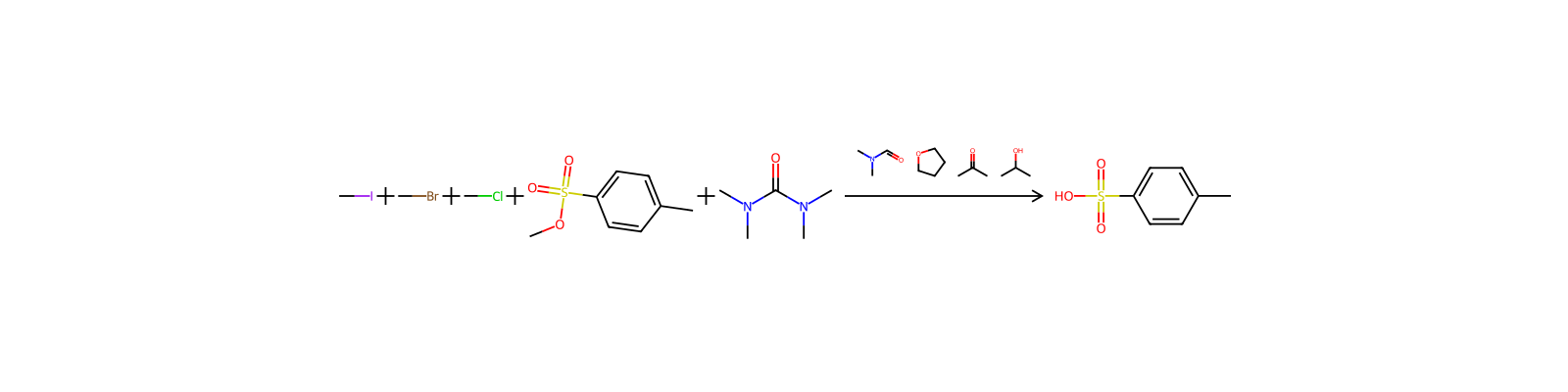
synthetischeMethyl p-toluenesulfonate was synthesized by the reaction of p-toluenesulfonyl chloride with methanol. Mix p-toluenesulfonyl chloride and methanol, slowly add 25% sodium hydroxide solution, control the temperature below 25 °C, stop adding alkali when the pH is 9, continue stirring for 2 hours, and leave overnight. The lower layer of reactant was taken, the upper layer was extracted with benzene, the extract was recovered with benzene and then combined with the lower layer, washed with water and 5% potassium carbonate solution in turn, dried and distilled under reduced pressure to obtain the finished product of methyl p-toluenesulfonate.
Vor- und nachgelagerte Produkte
Vorgelagerte Rohstoffe
Nachgelagerte Produkte
Anbieter50 Anbieter
国药集团化学试剂有限公司86-21-63210123 · [email protected]
梯希爱(上海)化成工业发展有限公司021-67121386 · [email protected]
衢州润东化工有限公司0570-8789886 18892685668 · [email protected]
上海阿拉丁生化科技股份有限公司400-6206333 13167063860 · [email protected]
爱斯特(成都)生物制药股份有限公司+86-28-85122536 85324413 · [email protected]
南京兰亚化工贸易有限公司+86-25-8331-5620 · [email protected]
韶远科技(上海)有限公司021-50795510 4000665055 · [email protected]
科瑞迪化学400-821-5857 021-64326257 · [email protected]
Syntechem Co.,Ltd[email protected]
阿法埃莎(中国)化学有限公司400-6106006 · [email protected]
安耐吉化学&3A(安徽泽升科技股份有限公司)400-0056266 · [email protected]
上海瀚鸿科技股份有限公司021-54306202 13764082696 · [email protected]
上海柯维化学技术有限公司021-64609169 18901607656 · [email protected]
上海景颜化工科技有限公司13817811078 · [email protected]
嘉兴市艾森化工有限公司0573-85285100 18627885956 · [email protected]
池州捷峰生物科技有限公司0566-8928158 · [email protected]
上海隆盛化工有限公司58099637 13585536065 · [email protected]
孝感深远化工有限公司15527621225; 15527621225 · [email protected]
山东西亚化学有限公司13355009207 13355009207 · [email protected]
玛雅试剂+86 (573) 82222445 (0)18006601000 452520369 · [email protected]
四川库利南科技有限公司400-1166-196 18981987031 · [email protected]
天津希恩思生化科技有限公司400 638 7771 · [email protected]
嘉兴信思得进出口有限公司+86 (573) 8203-0555 · [email protected]
Connect Chemicals GmbH+49 2102 2077 19 · [email protected]
寿光诺盟化工有限公司0536-5399456 13869682027 · [email protected]
斯百全化学(上海)有限公司021-021-021-67601398-809-809-809 15221380277 · [email protected]
艾科试剂4008-755-333 18080918076 · [email protected]
上海思域化工科技有限公司86-21-34053660 · [email protected]
赛默飞世尔科技(中国)有限公司800-810-5118 · [email protected]
北京伊诺凯科技有限公司400-810-7969 010-59572699 · [email protected]
上海健超生物科技有限公司150-2103-5486 18017383231 · [email protected]
TOKYO CHEMICAL INDUSTRY CO., LTD.03-36680489 · [email protected]
上海贤鼎生物科技有限公司4009209199 · [email protected]
深圳振强药物研发有限公司0755-66853366 13670046396 · [email protected]
随州市红旗化工有限公司0722-3257376 13026100080;13235518175 · [email protected]
越林试剂021-62960152 · [email protected]
北京环宇世纪化学科技有限公司hysj_bj.com
上海将来实业股份有限公司400-0066400 13621662912 · [email protected]
上海将来实业股份有限公司021-61552785 · [email protected]
HBCChem, Inc.+1-510-219-6317 · [email protected]
日照力德士化工有限公司010-51268198 · [email protected]
美岚实业(上海)有限公司021-58958189 · [email protected]
上海爱蝶实业有限公司021-58957966 18930537195 · [email protected]
成都零六生物科技有限公司400-1166-196 13458535857 · [email protected]
广拓化学(上海)有限公司021-60899189-8001 18918189673 · [email protected]
雷丁试剂0510-85629785 18013409632 · [email protected]
北京福源坊科技有限公司010-57903446 15869909019 · [email protected]
上海御略医药科技有限公司021-60345187 13671753212 · [email protected]
上海麦克林生化科技股份有限公司15221275939 15221275939 · [email protected]
杭州杰恒化工有限公司0571-87396432 · [email protected]
Zugehörige Reaktionen
446



Verknüpfte Notizen
Wird geladen…