Sodium hydride → 4-(3-Bromo-5-methoxy-benzyl)-3,4-dihydro-1H-quinoline-2-one
Reaktionsgleichung

[NH:1]1[C:10]2[C:5](=[CH:6][CH:7]=[CH:8][CH:9]=2)[CH2:4][CH2:3][C:2]1=[O:11].[H-].[Na+].[Br:14][C:15]1[CH:16]=[C:17]([CH:20]=[C:21]([O:23][CH3:24])[CH:22]=1)[CH2:18]Br>CN(C)C=O>[Br:14][C:15]1[CH:16]=[C:17]([CH:20]=[C:21]([O:23][CH3:24])[CH:22]=1)[CH2:18][CH:4]1[C:5]2[C:10](=[CH:9][CH:8]=[CH:7][CH:6]=2)[NH:1][C:2](=[O:11])[CH2:3]1Komponenten
Edukt 3

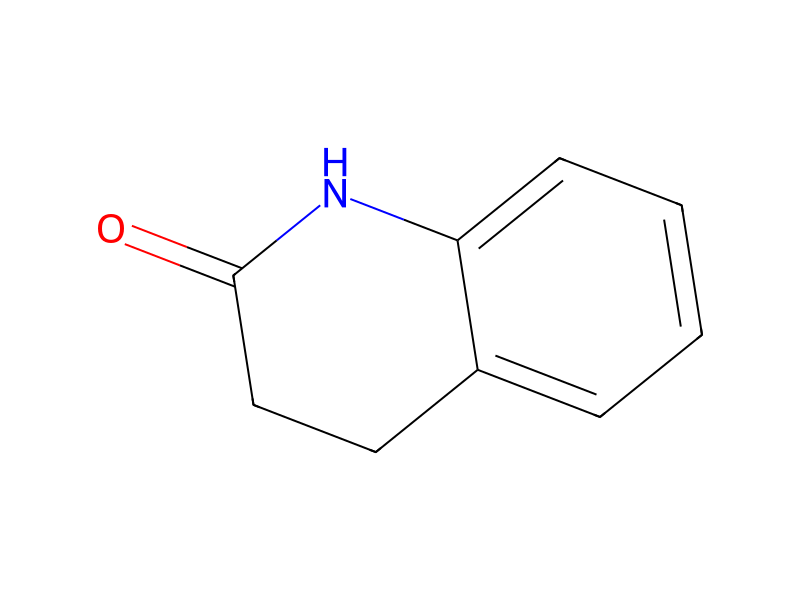

Produkt 1

Reagenzien, Katalysatoren, Lösungsmittel 1

Versuchsvorschrift
3,4-Dihydro-2(1H)-quinolinone was purchased from Aldrich Chemical Co. (Cat. No. 41,593-6) and used without purification in this step. 0.45 grams of 3,4-dihydro-2(1H)-quinolinone (3.0 mmole) was dissolved in 15 ml dimethylformamide and cooled in an ice bath. 0.2 grams (4.5 mmole) of sodium hydride (60% wt. in oil ) was added to this solution, and after 5 minutes 0.84 grams 3-bromo-5-methoxy-benzylbromide (3 mmol) was added thereto all at once. The mixture was stirred at ice bath temperature for 1 hour and then quenched by addition of 1% hydrochloric acid. The reaction mix was extracted with ethyl acetate, which was evaporated under reduced pressure to give an oil, which was chromatographed with medium pressure eluting using 10% ethyl acetate in hexanes to yield 0.8 grams of solid 4-(3-bromo-5-methoxy-benzyl)-3,4-dihydro-1H-quinoline-2-one.
Aufarbeitung
- custom41,593-6) and used without purification in this step
- temperaturecooled in an ice bath
- customquenched by addition of 1% hydrochloric acid
- additionThe reaction mix
- extractionwas extracted with ethyl acetate, which
- customwas evaporated under reduced pressure
- customto give an oil, which
- customwas chromatographed with medium pressure
- washeluting
Quellen und Nachweise
- ORD-Eintrag
- ord-a0bf169bfbea47dbbb490f8183a65566
- Quelldatensatz
- uspto-grants-2009_01
- Patentnummer
- US07476675B2
Notizen zur Reaktion
Wird geladen…