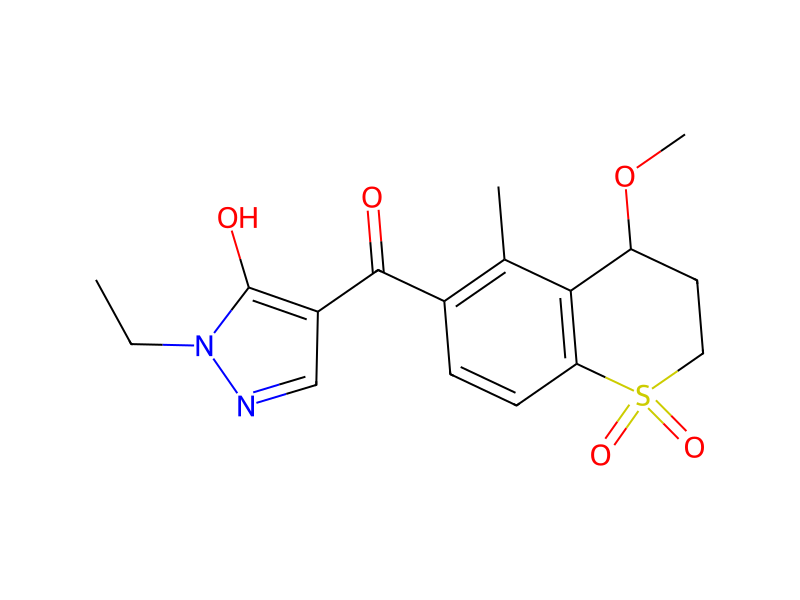
[CH3:1][O:2][CH:3]1[C:12]2[C:7](=[CH:8][CH:9]=[C:10]([C:14]([C:16]3[CH:17]=[N:18][N:19]([CH2:22][CH3:23])[C:20]=3[OH:21])=[O:15])[C:11]=2[CH3:13])[S:6](=[O:25])(=[O:24])[CH2:5][CH2:4]1.[CH2:26](Br)[C:27]1[CH:32]=[CH:31][CH:30]=[CH:29][CH:28]=1.C(=O)([O-])[O-].[K+].[K+].O>CC(C)=O>[CH3:1][O:2][CH:3]1[C:12]2[C:7](=[CH:8][CH:9]=[C:10]([C:14]([C:16]3[CH:17]=[N:18][N:19]([CH2:22][CH3:23])[C:20]=3[O:21][CH2:26][C:27]3[CH:32]=[CH:31][CH:30]=[CH:29][CH:28]=3)=[O:15])[C:11]=2[CH3:13])[S:6](=[O:24])(=[O:25])[CH2:5][CH2:4]14-Methoxy-5-methyl-6-(1-ethyl-5-hydroxypyrazol-4-yl) carbonylthiochroman-1,1-dioxide was used as a starting material (XIH). And, 0.4 g (1.10 mmol) thereof was dissolved in 5 ml of acetone, and 0.21 g (1.21 mmol) of benzyl bromide as a reaction reagent (XII) and 0.15 g (1.10 mmol) of potassium carbonate as a base were added. The resultant mixture was refluxed under heat for 3 hours. Water was added to the reaction mixture, and the reaction mixture was extracted with ethyl acetate. Its organic layer was separated, and dried over anhydrous sodium sulfate. Then, the solvent was distilled off under reduced pressure, and the resultant oil was purified with flush column chromatography (Wako Gel C-300: hexane/ethyl acetate=2:3) to give 0.37 g (yield 74%) of 4-methoxy-5-methyl-6-(5-benzyloxy-1-ethylpyrazol-4-yl)carbonylthiochroman-1,1-dioxide (Compound No. 62) as an end compound which comes under the general formula (XI). Table 21 shows the structures of the starting material (XIH) and the reaction reagent (XII), and the structure and the yield of the end product (I).