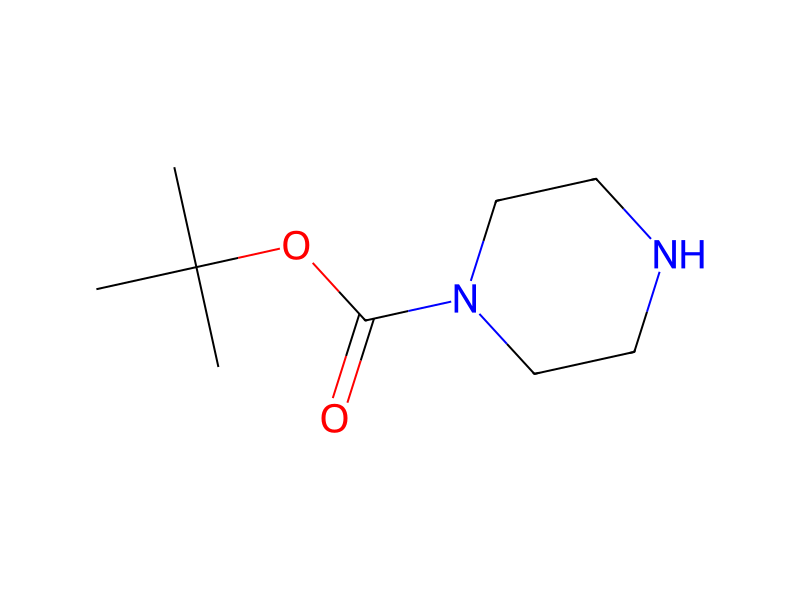
[N:1]1([C:7]([O:9][C:10]([CH3:13])([CH3:12])[CH3:11])=[O:8])[CH2:6][CH2:5][NH:4][CH2:3][CH2:2]1.Br[C:15]1[S:16][CH:17]=[C:18]([Br:20])[N:19]=1.C(N(CC)CC)C.O>CN(C)C=O>[Br:20][C:18]1[N:19]=[C:15]([N:4]2[CH2:5][CH2:6][N:1]([C:7]([O:9][C:10]([CH3:13])([CH3:12])[CH3:11])=[O:8])[CH2:2][CH2:3]2)[S:16][CH:17]=1To a solution of tert-butyl piperazine-1-carboxylate (767 mg, 4.12 mmol), 2,4-dibromo-1,3-thiazole (1.0 g, 4.12 mmol) in N,N-dimethylformamide (9 ml) was added triethylamine (0.86 ml, 6.18 mmol). The reaction mixture was stirred at 50° C. for 6 hrs and at 60° C. for 39 hrs. After cooling to room temperature, the reaction mixture was poured into water, and the mixture was extracted with ethyl acetate. The combined organic layer was washed with water and saturated brine, dried over anhydrous sodium sulfate, and concentrated. The residue was purified by silica gel column chromatography (dichloromethane:methanol=100:0→98:2) to give tert-butyl 4-(4-bromo-1,3-thiazol-2-yl)piperazine-1-carboxylate (1.09 g, yield 76%) as a pale-white brown solid.