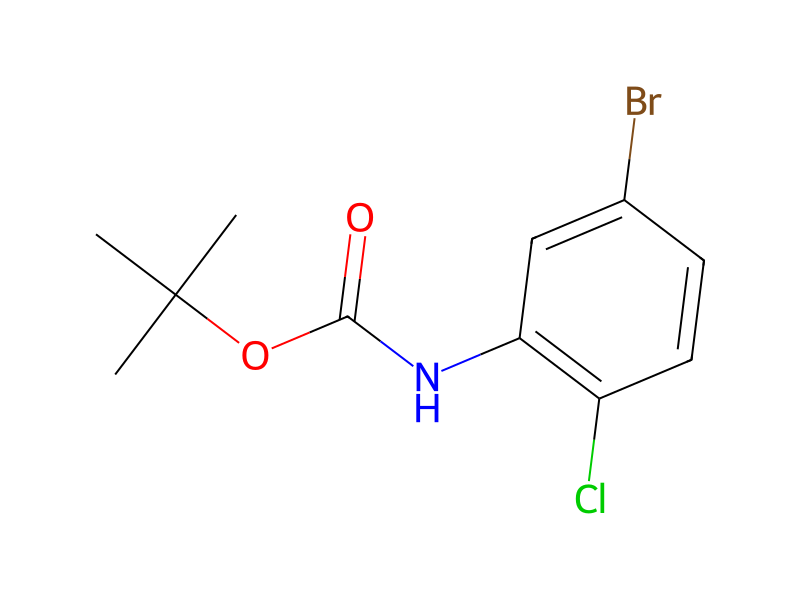
Br[C:2]1[CH:3]=[CH:4][C:5]([Cl:16])=[C:6]([NH:8][C:9](=[O:15])[O:10][C:11]([CH3:14])([CH3:13])[CH3:12])[CH:7]=1.[CH:17]1(/[CH:20]=[CH:21]/B2OC(C)(C)C(C)(C)O2)[CH2:19][CH2:18]1.C(=O)([O-])[O-].[K+].[K+]>C1(C)C=CC=CC=1.CCOC(C)=O.O>[Cl:16][C:5]1[CH:4]=[CH:3][C:2](/[CH:21]=[CH:20]/[CH:17]2[CH2:19][CH2:18]2)=[CH:7][C:6]=1[NH:8][C:9](=[O:15])[O:10][C:11]([CH3:14])([CH3:13])[CH3:12]A solution of tert-butyl 5-bromo-2-chlorophenylcarbamate (from the previous step) (1.0 eq.) and (E)-2-(2-cyclopropylvinyl)-4,4,5,5-tetramethyl-1,3,2-dioxaborolane (commercially available) (1.0 eq.) in toluene (0.2 M) was mixed with tetrakis(triphenyl-phosphine)palladium (5 mol %) and 2N aqueous potassium carbonate solution (2.0 eq.). The reaction was heated to 100° C. and stirred overnight. After cooling to ambient temperature, the reaction mixture was diluted with EtOAc and water. The two phases were separated, and the aqueous layer was extracted twice with EtOAc. The combined organic layers were washed with brine, dried over anhydrous MgSO4, and concentrated en vaccuo. The crude product was purified by flash chromatography on a COMBIFLASH® system (ISCO) using 0-5% EtOAc/Hexanes to give (E)-tert-butyl 2-chloro-5-(2-cyclopropylvinyl)phenylcarbamate as a pale yellow solid.