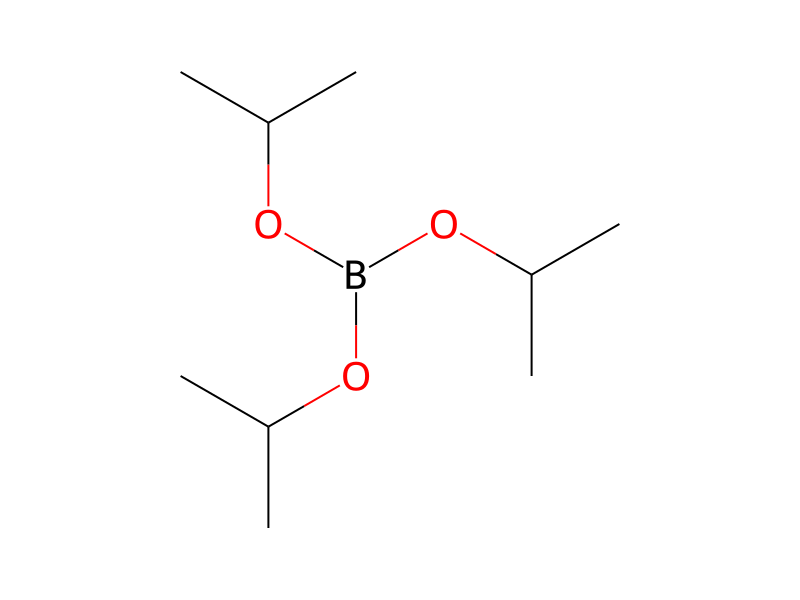
Triisopropylborate (0.76 mL, 3.29 mmol) and iodide 54 (815 mg, 2.53 mmol) were successively added via syringe to a mixture of anhydrous toluene (4 mL) and anhydrous distilled THF (1 mL) under N2 and the mixture was cooled to −78° C. n-Butyllithium (1.08 mL of a 2.5 M solution in hexanes, 2.70 mmol) was added drop-wise over 75 min to the stirred solution (at −78° C.), and the mixture was stirred at −78° C. for an additional 3 h, and then slowly warmed to −20° C. (over 1.5H). 2N HCl (2.6 mL) was added and the mixture was stirred at room temperature for 30 min, and then diluted with water (40 mL) and extracted with EtOAc (5×50 mL). The extracts were washed with brine (50 mL) and then evaporated to dryness. The residue was triturated in pentane (˜3-4 mL), cooled to −78° C., and rapidly filtered cold (washing with pentane cooled to −78° C.) to give 3-chloro-4-(trifluoromethoxy)phenylboronic acid (55) (459 mg, 76%) as a white solid (a 1:1 mixture of the trimeric boroxine and the boronic acid by NMR): mp 202-204° C.; 1H NMR (CDCl3) δ 8.26 (d, J=1.5 Hz, 3H, boroxine), 8.12 (dd, J=8.2, 1.5 Hz, 3H, boroxine), 7.85 (d, J=1.5 Hz, 1H, boronic acid), 7.65 (dd, J=8.2, 1.6 Hz, 1H, boronic acid), 7.48 (dq, J=8.2, 1.5 Hz, 3H, boroxine), 7.35 (dq, J=8.2, 1.5 Hz, 1H, boronic acid), 4.57 (s, 2H, boronic acid).