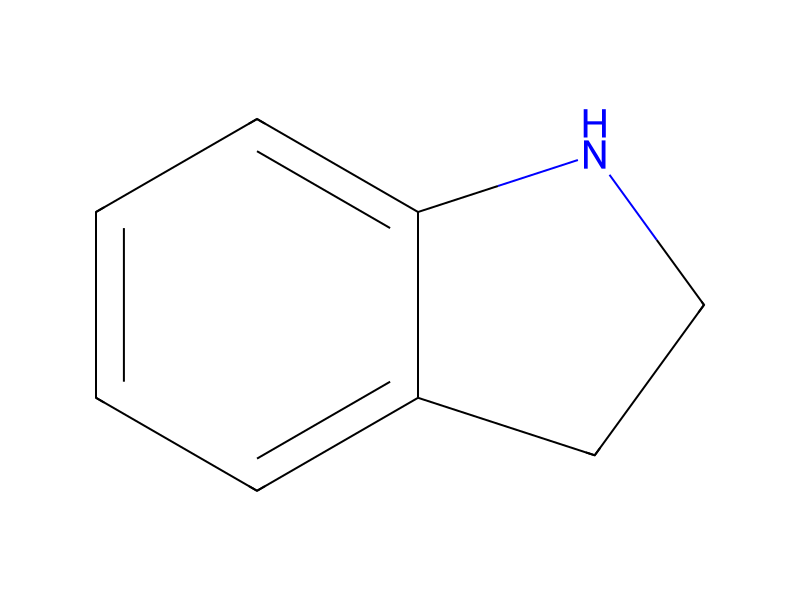
C(OC)#N.N1C2C(=CC=CC=2)CC1.C([N:17]1[C:25]2[C:20](=[C:21]([CH3:39])[C:22]([CH2:34][O:35]C(=O)C)=[C:23]([CH3:33])[C:24]=2[NH:26][C:27](=[O:32])[C:28]([CH3:31])([CH3:30])[CH3:29])[CH2:19][CH2:18]1)(=O)C.[OH-].[Na+]>CCO.O>[OH:35][CH2:34][C:22]1[C:21]([CH3:39])=[C:20]2[C:25](=[C:24]([NH:26][C:27](=[O:32])[C:28]([CH3:29])([CH3:30])[CH3:31])[C:23]=1[CH3:33])[NH:17][CH2:18][CH2:19]21.27 (9H, s, —C(CH3)3), 2.04 (3H, s, OCOCH3), 2.23, 2.26, 2.30 (9H, s×3, —CH3×2, >NCOCH3), 3.00 (2H, br, Indoline C3-H), 4.05 (2H, br, Indoline C2—H), 5.20 (2H, s, —CH2O—), 9.10 (1H, br, >NH). (2) N-(1-Acetyl-5-acetoxymethyl-4,6-dimethylindolin-7-yl)-2,2-dimethyl-propanamide (7.5 g) was dissolved in EtOH (70 ml) and a solution of NaOH (8.3 g) in water (20 ml) was added, which was followed by refluxing for 10 hr. EtoH was evaporated under reduced pressure and CHCl3 (200 ml) was added. After washing with water, the mixture was dried over anhydrous sodium sulfate and CHCl3 was evaporated under reduced pressure. The residue was purified by silica gel column chromatography (eluent: CHCl3/MeOH=1/0−10/1) to give 3.0 g of N-(5-hydroxymethyl-4,6-dimethylindolin-7-yl)-2,2-dimethylpropanamide.