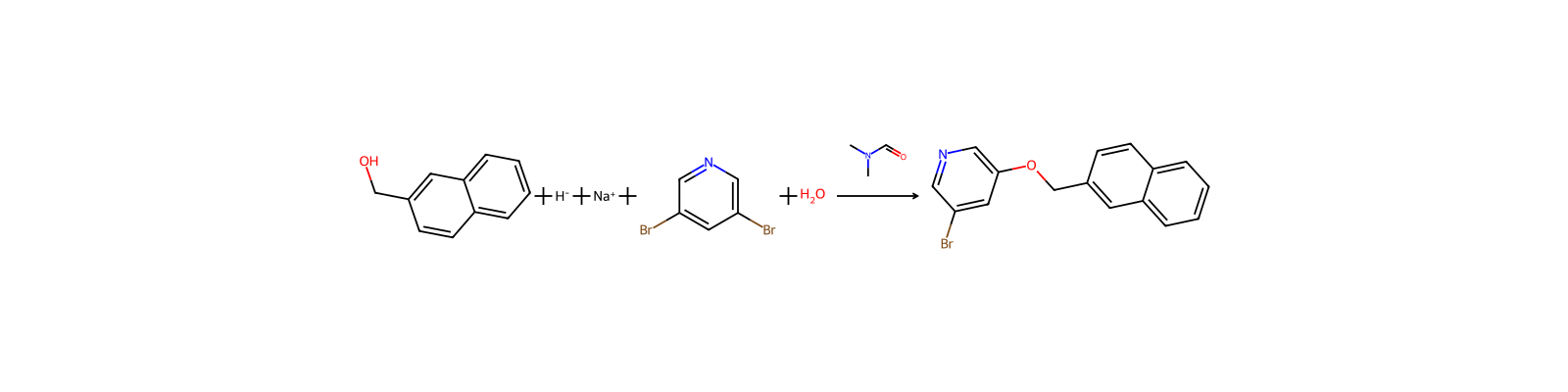
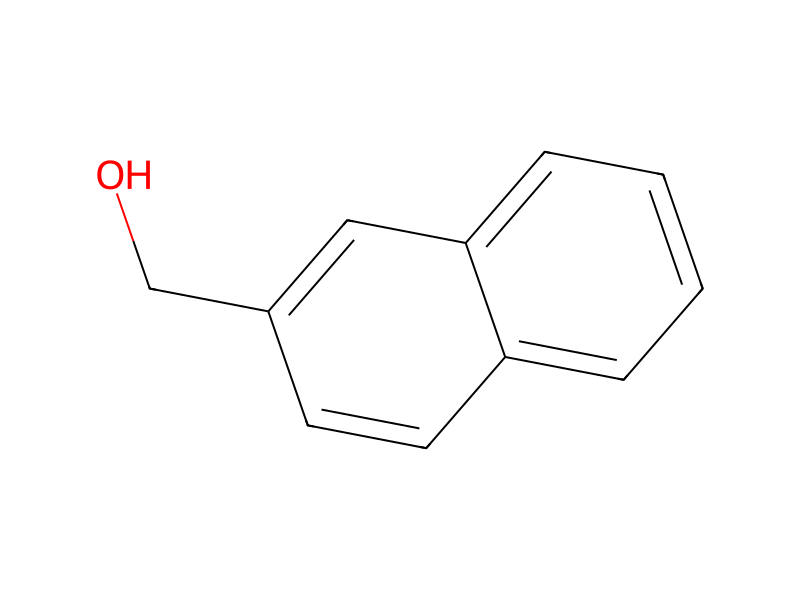
[CH:1]1[C:10]2[C:5](=[CH:6][CH:7]=[CH:8][CH:9]=2)[CH:4]=[CH:3][C:2]=1[CH2:11][OH:12].[H-].[Na+].[Br:15][C:16]1[CH:17]=[N:18][CH:19]=[C:20](Br)[CH:21]=1.O>CN(C)C=O>[Br:15][C:16]1[CH:17]=[N:18][CH:19]=[C:20]([O:12][CH2:11][C:2]2[CH:3]=[CH:4][C:5]3[C:10](=[CH:9][CH:8]=[CH:7][CH:6]=3)[CH:1]=2)[CH:21]=1A solution of 2-naphthylmethanol (1.58 g) in dimethylformamide (20 ml) was added to a slurry of sodium hydride (55% w/w dispersion in oil, 0.48 g) in dimethylformamide (2 ml) and the mixture was stirred at ambient temperature for 20 minutes. 3,5-Dibromopyridine (2.37 g) was added and the solution was heated to 120° C. for 5 hours and then allowed to stand at ambient temperature overnight. The mixture was poured into water (160 ml) and extracted with ethyl acetate (3×50 ml). The combined extracts were washed with water, dried (MgSO4) and evaporated. The residue was purified by column chromatography eluting with increasingly polar mixtures of petrol (b.p. 60°-80° C.) and ethyl acetate to give 3-bromo-5-(naphth-2-ylmethoxy)pyridine (1.4 g), m.p. 108°-109° C.