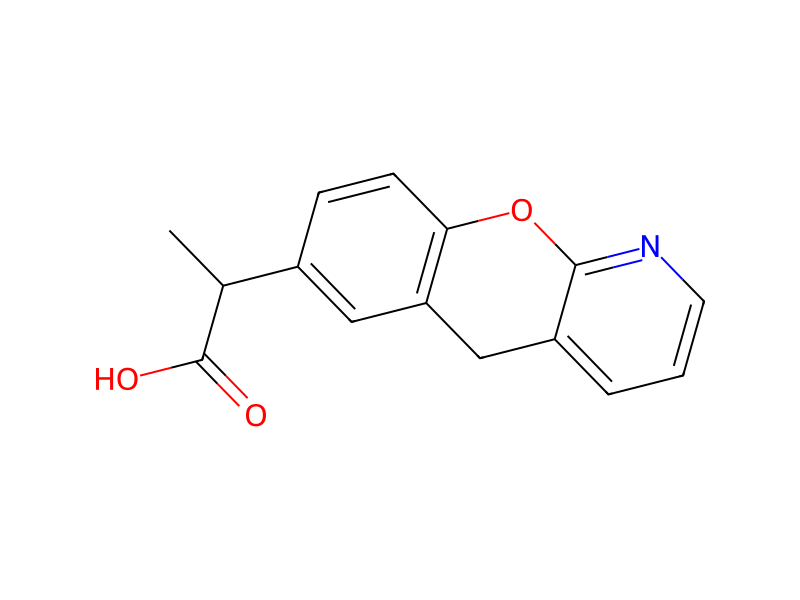
[Mg].Br[CH:3]([C:5]1[CH:6]=[CH:7][C:8]2[O:17][C:12]3=[N:13][CH:14]=[CH:15][CH:16]=[C:11]3[CH2:10][C:9]=2[CH:18]=1)[CH3:4].[C:19](=[O:21])=[O:20].Cl>O1CCCC1>[N:13]1[CH:14]=[CH:15][CH:16]=[C:11]2[CH2:10][C:9]3[CH:18]=[C:5]([CH:3]([CH3:4])[C:19]([OH:21])=[O:20])[CH:6]=[CH:7][C:8]=3[O:17][C:12]=12A Grignard reagent is prepared from 0.31 g of metallic magnesium and 2.9 g of 7-(1-bromoethyl)-5H-[1]benzopyrano[2,3-b]pyridine in 10 ml of anhydrous tetrahydrofuran. To the Grignard reagent is added a large excess of dry ice. The mixture is allowed to stand overnight, and then poured into diluted hydrochloric acid. The precipitate is filtered off, and added to an aqueous sodium bicarbonate solution. An insoluble material is removed by filtration, and the filtrate is made acid with acetic acid. The resulting white crystals are collected and recrystallized from aqueous dioxane to give 2-(5H-[1]benzopyrano[2,3-b]pyridin-7-yl)propionic acid melting at 182.5°-183.5°C.
Wird geladen…