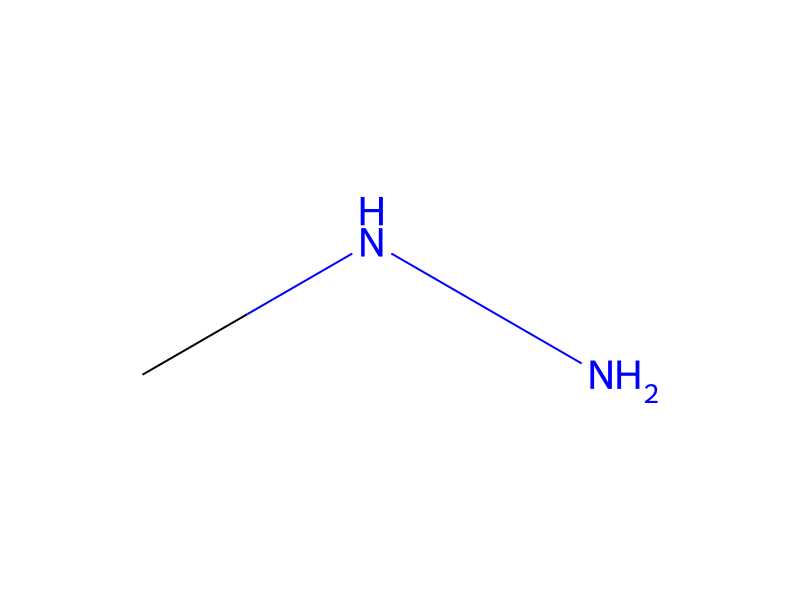
32.8 g (0.20 mol) of 2-benzyl-1,3-dioxolane are introduced, at a temperature of between 50° C. and 65° C., into a reactor containing 57.6 g (0.45 mol) of N,N-dimethylchloromethyliminium chloride in solution in 150 ml of chloroform and the solution is then heated for 1 h to 65° C. The chloroform is removed under reduced pressure and 11.5 g (0.25 mol) of monomethylhydrazine in aqueous solution at a concentration of 30% are then introduced at 50° C. The solution is heated for 2 h at 70° C. It is cooled to 20° C. and then neutralised to pH =8 with an aqueous 30% sodium hydroxide solution. 10 ml of water are then added and the required product is then extracted with 2 15-ml portions of methylene chloride. The extraction solvent is removed. A crude product is thus obtained, which was purified by recrystallisation from isopropyl ether. The purified product, 1-methyl-4-phenylpyrazole, identified by 1H NMR and mass spectrometry, has a melting point of 103.6° C. The yield of 1-methyl-4-phenylpyrazole formed, determined by quantitative analysis of the crude product, is 46%.