StartseiteMCPWorkbenchSkills
StartseiteWorkbenchBenachrichtigungenMein Bereich
llms.txt · MCP-AnleitungDatenschutz · Nutzungsbedingungen · Supportv1.8.3
  1. Startseite
  2. /Reaktion

Tris(1,1-dimethylethyl)phosphine → 2-(4'-Vinyl-biphenyl-4-yl)pyridine

HRID 1639944
Drucken

Reaktionsgleichung

Reaktionsgleichung von HRID 1639944
[CH:1]([C:3]1[CH:8]=[CH:7][C:6](B(O)O)=[CH:5][CH:4]=1)=[CH2:2].Cl[C:13]1[CH:18]=[CH:17][C:16]([C:19]2[CH:24]=[CH:23][CH:22]=[CH:21][N:20]=2)=[CH:15][CH:14]=1.F[K].C(P)(C)(C)C.P(C(C)(C)C)(C(C)(C)C)C(C)(C)C>C(=CC(C=CC1C=CC=CC=1)=O)C1C=CC=CC=1.C(=CC(C=CC1C=CC=CC=1)=O)C1C=CC=CC=1.C(=CC(C=CC1C=CC=CC=1)=O)C1C=CC=CC=1.[Pd].O1CCOCC1>[CH:1]([C:3]1[CH:8]=[CH:7][C:6]([C:13]2[CH:14]=[CH:15][C:16]([C:19]3[CH:24]=[CH:23][CH:22]=[CH:21][N:20]=3)=[CH:17][CH:18]=2)=[CH:5][CH:4]=1)=[CH2:2]
KomponentenReaktionsbedingungenVersuchsvorschriftAufarbeitungQuellen und NachweiseNotizen zur Reaktion

Komponenten

8

Edukt 5

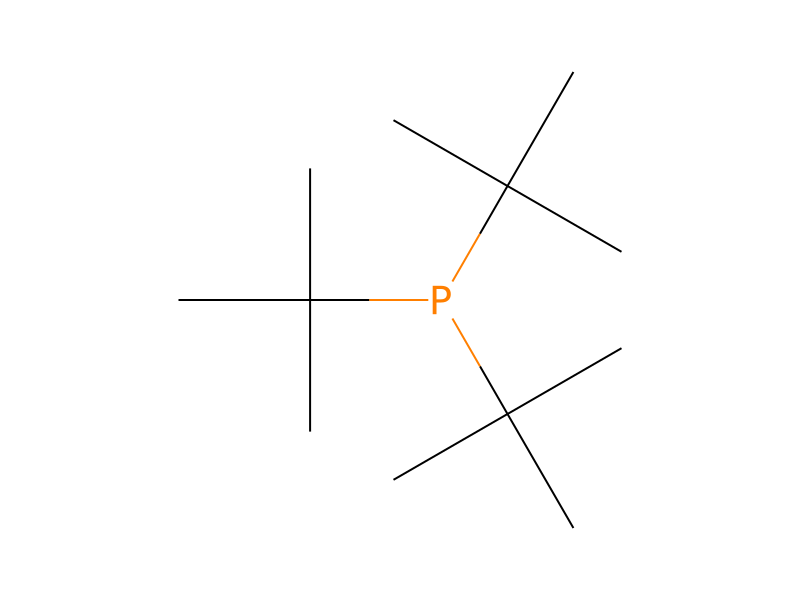
HCID 83681Tris(1,1-dimethylethyl)phosphineHCID 123165tert-ButylphosphineHCID 27343934-Vinylphenylboronic acidHCID 27578492-(4-Chlorophenyl)pyridineHCID 178506427HCID 178506427, Verbindung

Produkt 1

HCID 667224942-(4'-Vinyl-biphenyl-4-yl)pyridine
Ausbeute 45 %

Reagenzien, Katalysatoren, Lösungsmittel 2

HCID 44556509Tris(dibenzylideneacetone) palladiumKatalysatorHCID 312751,4-DioxaneLösungsmittel

Reaktionsbedingungen

Temperatur
80 °C

Versuchsvorschrift

Under a nitrogen stream, 23.42 g (0.158 mol) of 4-vinyl-phenyl boronic acid, 20.0 g (0.1055 mol) of 2-(4-chloro-phenyl)pyridine, 500□ of 1,4-dioxane, 27.54 g (0.474 mol, 3.3 equivalent) of fluoro-potassium, 1.69 g (0.0084 mol, 5.3 mol %) of t-butylphosphine [P(t-Bu)3)], and 2.6 g (0.0028 mol, 1.8 mol %) of palladium tris(dibenzylidene acetone) [Pd2(dba)3] were placed into a 2-neck round flask 250□. After the resulting solution was heated to reflux at 80° C. for 24 hours, the reaction was terminated. The resulting mixture was filtered, the catalyst and fluoro-potassium that were black solids were removed, and then the dioxane was removed by rotary evaporation. After extraction with 300□ of dichloromethane and 400□ of distilled water, the residue was subjected to column chromatography using a mixed solution of hexane and ethylacetate (7:3) as a developing solvent and then recrystallized at 0° C. using ethylacetate to give the 2-(4′-vinyl-biphenyl-4-yl)pyridine. The yield was 45%. As the structural characteristics of the thus prepared 2-(4′-vinyl-biphenyl-4-yl)pyridine, the 1H-NMR spectrum is shown in FIG. 2, the UV/Vis is shown in FIG. 3, the GC-Mass is shown in FIG. 4, and the FT-IR is shown in FIG. 5. Moreover, the analysis data of the 2-(4′-vinyl-biphenyl-4-yl)pyridine is shown in the following table 1:

Aufarbeitung

  1. temperatureAfter the resulting solution was heated
  2. customthe reaction was terminated
  3. filtrationThe resulting mixture was filtered
  4. customwere removed
  5. customthe dioxane was removed by rotary evaporation
  6. extractionAfter extraction with 300□ of dichloromethane and 400□ of distilled water
  7. customrecrystallized at 0° C.

Quellen und Nachweise

ORD-Eintrag
ord-1455a27782084f089190e0cebd8c079e
Quelldatensatz
uspto-grants-2012_02
DOI
10.6084/m9.figshare.5104873.v1
Patentnummer
US08110642B2

Notizen zur Reaktion

Auf dieser SeiteKomponentenReaktionsbedingungenVersuchsvorschriftAufarbeitungQuellen und NachweiseNotizen zur Reaktion
