Reaktionsgleichung

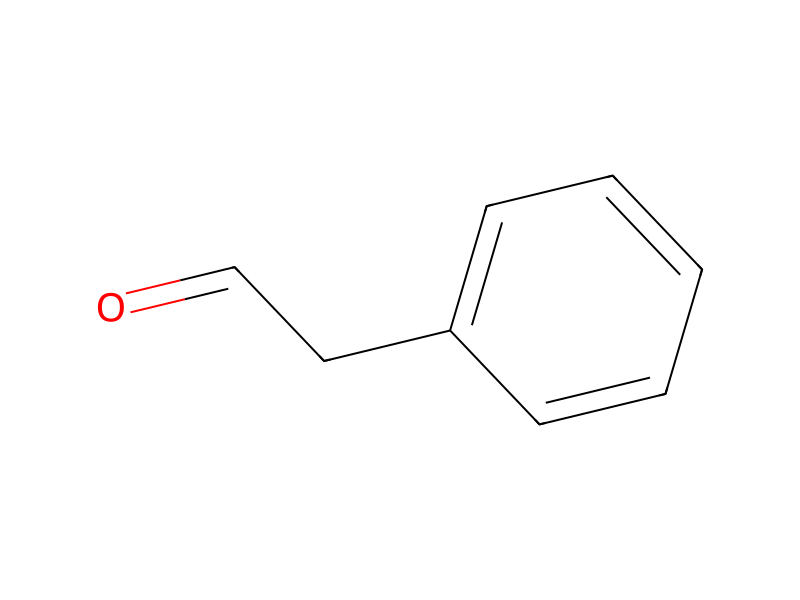
[C:1]1([CH2:7][CH:8]=[O:9])[CH:6]=[CH:5][CH:4]=[CH:3][CH:2]=1.[C:10]([S:12]SC#N)#[N:11]>>[C:1]1([CH:7]([S:12][C:10]#[N:11])[CH:8]=[O:9])[CH:6]=[CH:5][CH:4]=[CH:3][CH:2]=1Komponenten


Versuchsvorschrift
In synthesis of 5-phenylthiazole derivatives, the intermediate α-bromo-α-phenylacetaldehyde is first synthesized by allowing phenylacetaldehyde to react with bromine according to the method as disclosed in Helv. Chim. Acta. Vol. 30, pp.2058 (1945). As the next step, according to the method disclosed in J. Amer. Chem. Soc. Vol. 71, pp.4007 (1949), α-bromo-α-phenylacetaldehyde is allowed to react respectively with thioformaldehyde, thioacetamide, thiourea and ethylthiocarbamate at room temperature in methanol as a reaction solvent to obtain 5-phenylthiazole (m.p. 45°-46° C.), 2-methyl-5-phenylthiazole (m.p. 74°-76° C.), 2-amino-5-phenylthiazole (m.p. 206°-208° C.) and 2-hydroxy-5-phenylthiazole (m.p. 202°-204° C.). On the other hand, according to the method as described in U.S. Pat. No. 2,603,646 (1952), phenylacetaldehyde is allowed to react with thiocyanogen to obtain α-phenyl-α-thiocyanoacetaldehyde, which is then allowed to react with ammonium dithiocarbamate in the presence of an acid catalyst such as dilute sulfuric acid to obtain 2-mercapto-5-phenylthiazole (m.p. 207°-209° C.).
Quellen und Nachweise
- ORD-Eintrag
- ord-0a4c382f90604bcc8b7c5cd7fe4be728
- Quelldatensatz
- uspto-grants-1983_11
- Patentnummer
- US04418070
Verknüpfte Notizen
Wird geladen…