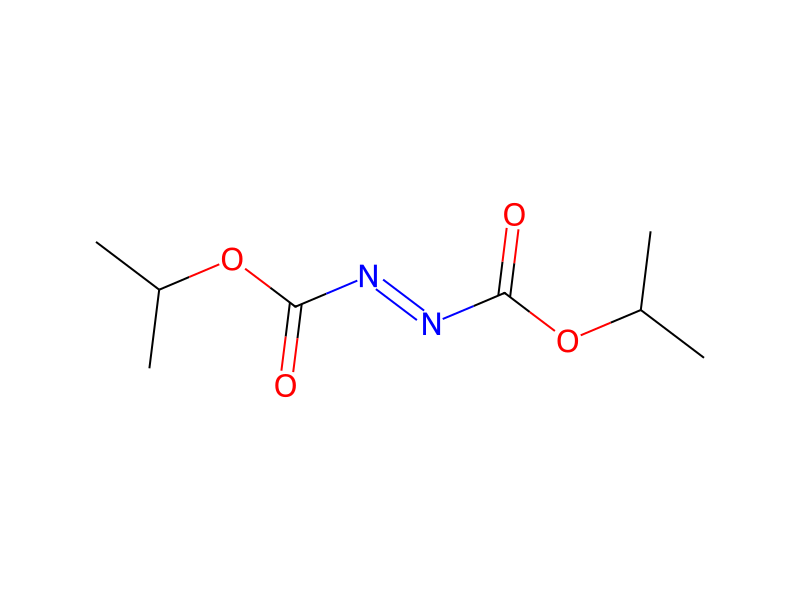
CC(OC(/N=N/C(OC(C)C)=O)=O)C.[NH:15]1[CH2:20][CH2:19][CH:18]([C:21]2[CH:26]=[CH:25][C:24]([OH:27])=[CH:23][CH:22]=2)[CH2:17][CH2:16]1.[CH3:28][N:29]1[C:33]([CH2:34][CH2:35]O)=[CH:32][CH:31]=[N:30]1.C1(P(C2C=CC=CC=2)C2C=CC=CC=2)C=CC=CC=1>C(Cl)Cl>[CH3:28][N:29]1[C:33]([CH2:34][CH2:35][O:27][C:24]2[CH:23]=[CH:22][C:21]([CH:18]3[CH2:19][CH2:20][NH:15][CH2:16][CH2:17]3)=[CH:26][CH:25]=2)=[CH:32][CH:31]=[N:30]1DIAD (64.8 μl, 0.33 mmol) was added to 4-(piperidin-4-yl)phenol (CAS 263139-27-1, 53 mg, 0.30 mmol), 2-(1-methyl-1H-pyrazol-5-yl)ethanol (obtained as described in PCT Int. Appl. WO 2007017222, Intermediate 1) (37.7 mg, 0.30 mmol) and triphenylphosphine (86 mg, 0.33 mmol) in DCM (3 mL) at 20° C. under nitrogen. The resulting mixture was stirred at 22° C. for 3 days. The reaction mixture was purified by ion exchange chromatography, using an SCX column. The desired product was eluted from the column using 7M ammonia in methanol and pure fractions were evaporated to dryness to afford 4-[4-[2-(1-methyl-1H-pyrazol-5-yl)ethoxy]phenyl]piperidine (85 mg, 96%) as a yellow oil.