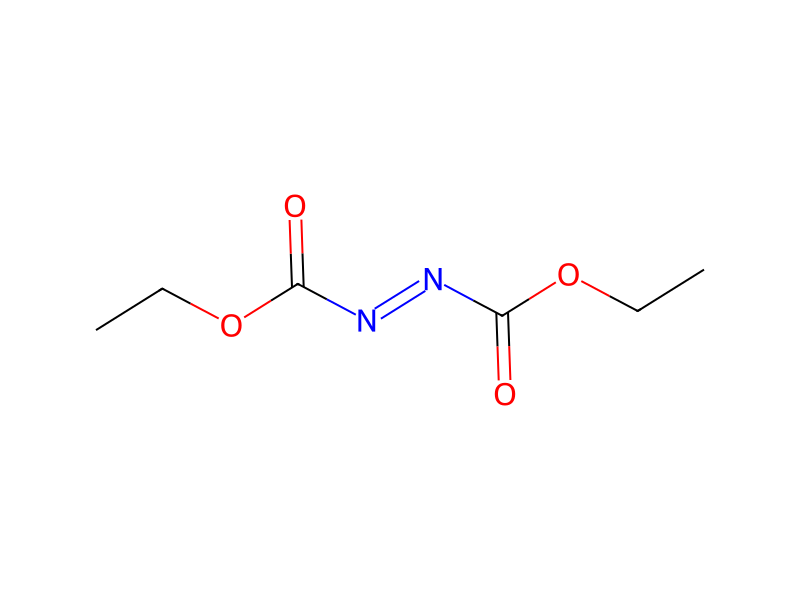
[CH3:1][C:2]([CH3:16])([CH3:15])[CH:3]([C:5]1[CH:10]=[CH:9][C:8]([S:11][CH2:12][CH2:13][CH3:14])=[CH:7][CH:6]=1)O.C1(P(C2C=CC=CC=2)C2C=CC=CC=2)C=CC=CC=1.N(C(OCC)=O)=NC(OCC)=O.C1(P([N:62]=[N+:63]=[N-:64])(C2C=CC=CC=2)=O)C=CC=CC=1>C1COCC1.O>[N:62]([CH:3]([C:5]1[CH:10]=[CH:9][C:8]([S:11][CH2:12][CH2:13][CH3:14])=[CH:7][CH:6]=1)[C:2]([CH3:16])([CH3:15])[CH3:1])=[N+:63]=[N-:64]To a stirred solution of 2,2-dimethyl-1-[4-(propylthio)phenyl)propan-1-ol (466 mg, 1.95 mmol) in THF (10 ml) were added triphenylphosphine (666 mg, 2.54 mmol), diethyl azodicarboxylate (0.40 ml, 2.54 mmol), and finally diphenylphosphoryl azide (0.55 ml, 2.54 mmol). The mixture was stirred at room temperature over for 3 days. Water (1 ml) was added and the mixture was evaporated. The residue was partitioned between ethyl acetate (50 ml) and water (30 ml). The organic phase was separated, washed with brine (30 ml), dried over MgSO4, filtered and evaporated to give an oil. The crude product was chromatographed on silica eluting with 4% EtOAc in hexanes to give the title product as a pale yellow oil (284 mg). 1H NMR δ (CDCl3) 7.29-7.27 (2H, m), 7.17-7.15 (2H, m), 4.23 (1H, s), 2.92 (2H, t, J=7.3 Hz), 1.73-1.67 (2H, m), 1.04 (3H, t, J=7.4 Hz), 0.90 (9H, s).