Reaktionsgleichung

[Br:1][C:2]1[CH:3]=[C:4]([CH:8]=[CH:9][C:10]=1[F:11])[C:5](F)=[O:6].[BH4-].[Na+].Cl>C(O)(C)C>[Br:1][C:2]1[CH:3]=[C:4]([CH:8]=[CH:9][C:10]=1[F:11])[CH2:5][OH:6]Komponenten
5
Edukt 3



Produkt 1
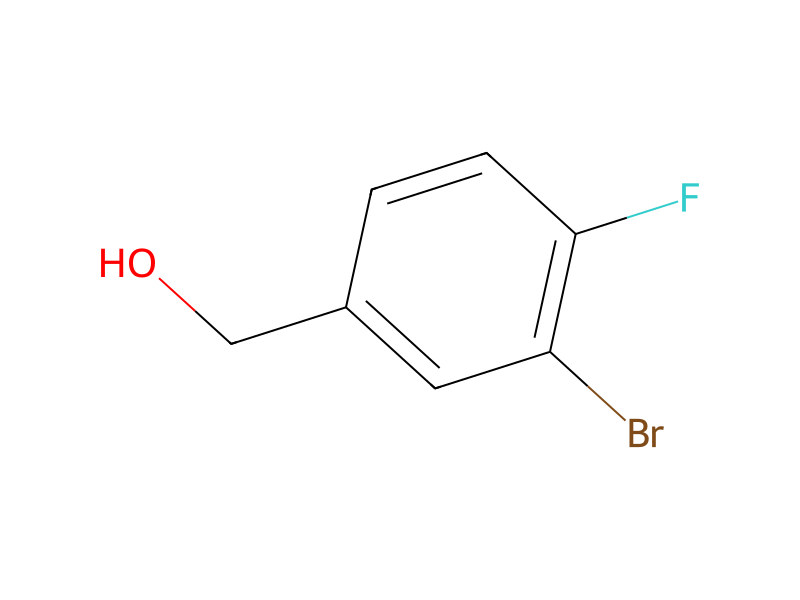
Reagenzien, Katalysatoren, Lösungsmittel 1

Versuchsvorschrift
221 g (1 mol) of 3-bromo-4-fluoro-benzoyl fluoride were added dropwise to a mixture of 30.4 g (0.8 mol) of sodium tetrahydridoborate and 840 ml of isopropanol at 20°-25° C. in the course of 3 hours. The reaction mixture was stirred for about a further 30 minutes and then poured into 2 liters of ice-water. The pH was adjusted to 1 by adding concentrated hydrochloric acid, and the organic layer was then separated off. The aqueous phase was subsequently extracted with 200 ml of methylene chloride. The combined organic phases were dried and filtered and the filtrate was distilled. 163 g (79.5% of theory) of 3-bromo-4-fluorobenzyl alcohol of boiling point 137° C./16 mbars and of refractive index nD20 =1.5623 were obtained.
Aufarbeitung
- customthe organic layer was then separated off
- extractionThe aqueous phase was subsequently extracted with 200 ml of methylene chloride
- customThe combined organic phases were dried
- filtrationfiltered
- distillationthe filtrate was distilled
Quellen und Nachweise
- ORD-Eintrag
- ord-9d0d5d261f1140dabd6c9548ef0ed659
- Quelldatensatz
- uspto-grants-1983_04
- Patentnummer
- US04381412
Verknüpfte Notizen
Wird geladen…