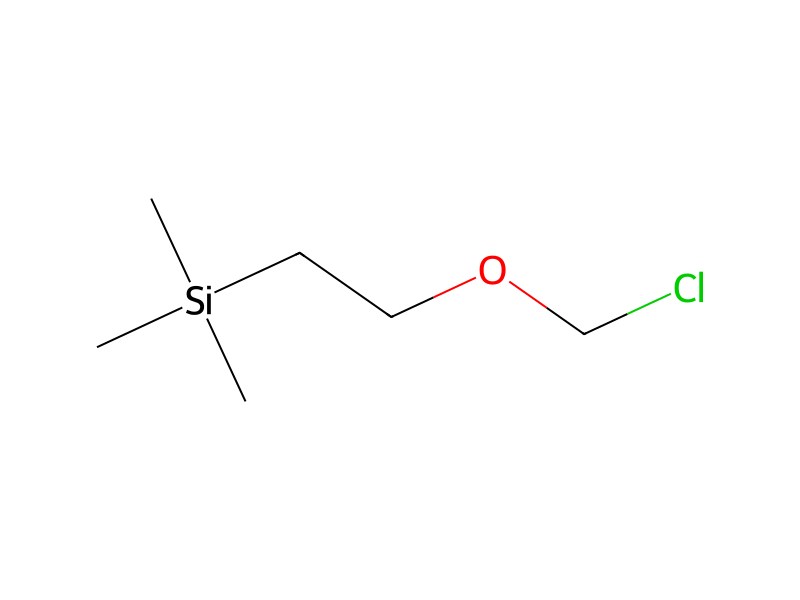
[CH3:1][O:2][C:3](=[O:16])[O:4][C:5]1[CH:14]=[C:13]([OH:15])[C:12]2[C:7](=[CH:8][CH:9]=[CH:10][CH:11]=2)[CH:6]=1.[CH3:17][Si:18]([CH3:25])([CH3:24])[CH2:19][CH2:20][O:21][CH2:22]Cl.C(N(C(C)C)C(C)C)C>C(Cl)Cl>[CH3:17][Si:18]([CH3:25])([CH3:24])[CH2:19][CH2:20][O:21][CH2:22][O:15][C:13]1[C:12]2[C:7](=[CH:8][CH:9]=[CH:10][CH:11]=2)[CH:6]=[C:5]([O:4][C:3](=[O:16])[O:2][CH3:1])[CH:14]=14.62 g (21.2 mmol) of carbonic acid 4-hydroxy-naphthalen-2-yl ester methyl ester [Journal of Agricultural and Food Chemistry (1994), 42(12), 2970-2] was dissolved in 150 ml of MeCl2, 4.95 ml=4.71 g (25.4 mmol) of 2-(trimethylsilyl)-ethoxymethylchloride was added and this mixture cooled down to 2° C. 11.1 ml=8.38 g (63.5 mmol) of N-ethyl-diisoproylamine was added drop by drop and then, reaction was warmed up to ambient temperature. After 48 hours, it was poured into crashed ice and extracted twice with MeCl2; the organic phases were washed with water, dried (MgSO4) and evaporated. The crude product was purified by flash chromatography (SiO2, gradient of n-heptane/MeCl2) to give 5.57 g of carbonic acid methyl ester 4-(2-trimethylsilanyl-ethoxymethoxy)-naphthalen-2-yl ester as colorless oil.
Wird geladen…