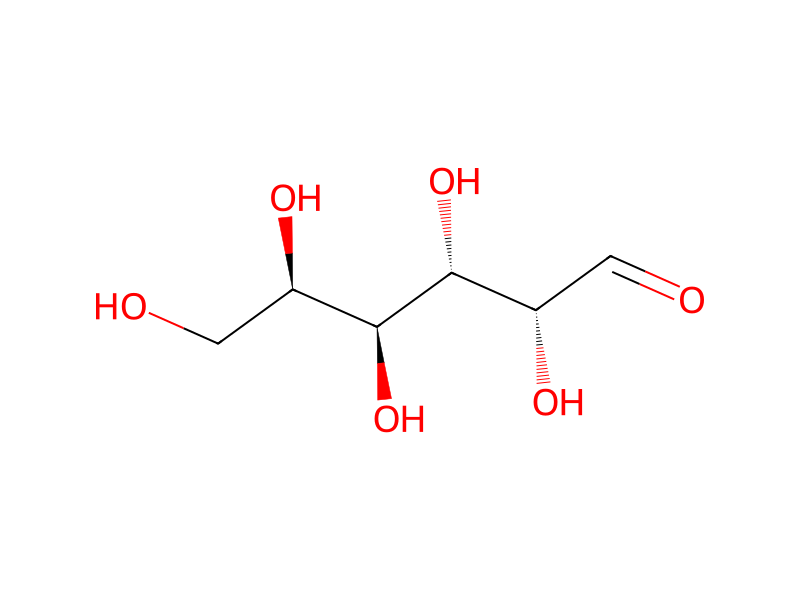
(2R,3S,4R,5R)-2,3,4,5,6-pentahydroxyhexanal → (3S,4S,5R)-1,3,4,5,6-pentahydroxyhexan-2-one
Reaktionsgleichung

[O:1]=[CH:2][C@@H:3]([C@H:5]([C@H:7]([C@@H:9]([CH2:11][OH:12])[OH:10])[OH:8])[OH:6])[OH:4].O=C[C@@H]([C@H]([C@@H]([C@@H](CO)O)O)O)O>>[OH:1][CH2:2][C:3]([C@H:5]([C@H:7]([C@@H:9]([CH2:11][OH:12])[OH:10])[OH:8])[OH:6])=[O:4]Komponenten
3


Versuchsvorschrift
D-tagatose is typically produced in a two-step process wherein lactose is enzymatically hydrolyzed to d-Galactose and d-glucose using immobilized lactase. The d-galactose is typically separated using a cation exchange resin. The separated d-galactose is then isomerized to produce d-tagatose under alkaline conditions (typically at a pH of 12) using calcium hydroxide to form a precipitate. The precipitate is subsequently treated with sulfuric acid to free the d-tagatose, and the filtrate is demineralized in a cation and anion exchanger. Typically, the resulting solution is concentrated and purified by chromatic fractionation using a cation exchanger. The d-tagatose is recovered by crystallization.