Reaktionsgleichung
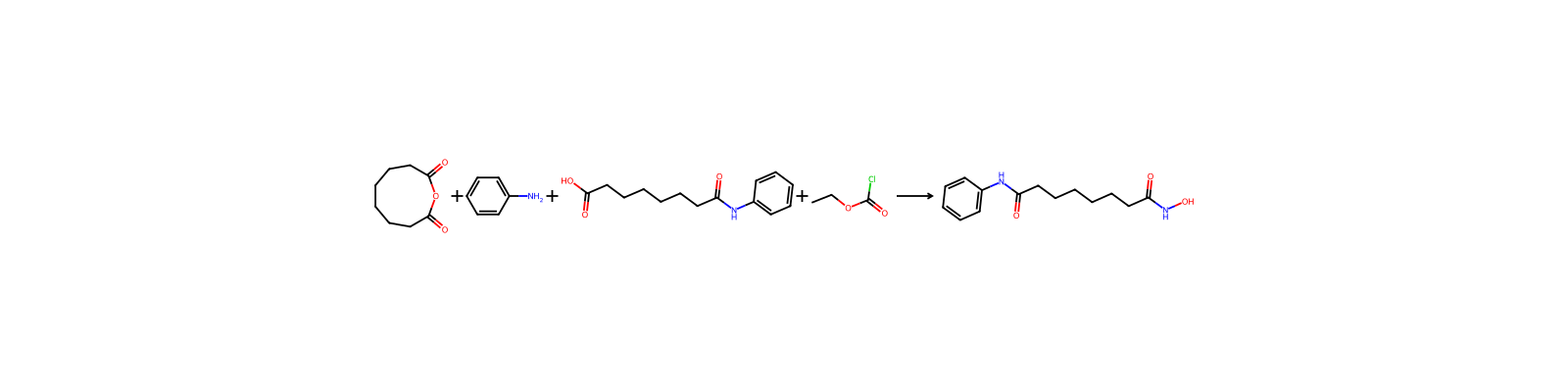
C1(=O)OC(=[O:9])CCCCCC1.[NH2:12][C:13]1[CH:18]=[CH:17][CH:16]=[CH:15][CH:14]=1.[C:19]([OH:36])(=O)[CH2:20][CH2:21][CH2:22][CH2:23][CH2:24][CH2:25][C:26]([NH:28]C1C=CC=CC=1)=[O:27].ClC(OCC)=O>>[CH:16]1[CH:15]=[CH:14][C:13]([NH:12][C:19]([CH2:20][CH2:21][CH2:22][CH2:23][CH2:24][CH2:25][C:26]([NH:28][OH:9])=[O:27])=[O:36])=[CH:18][CH:17]=1Komponenten




Versuchsvorschrift
Another process for the preparation of vorinostat has been reported in OPPI Briefs, 2001, vol. 33(4), pages 391-394. The reported process, illustrated in Scheme 6, involves conversion of suberic acid to suberic anhydride, which on treatment with aniline gives suberanilic acid. Coupling of this suberanilic acid with ethyl chloroformate gives a mixed anhydride which upon treatment with hydroxylamine gives vorinostat in an overall yield of 58%. In the first step, there is competition between the formation of suberic anhydride and the linear anhydride and consequently isolation of pure suberic anhydride from the reaction mixture is very difficult. This process step is also hindered by the formation of process impurities and competitive reactions. In the second step, there is formation of dianilide by reaction of two moles of aniline with the linear anhydride. In the third step, suberanilic acid is an inconvenient by-product as the suberanilic acid is converted to a mixed anhydride with ethyl chloroformate, which is highly unstable and is converted back into suberanilic acid. Consequently, it is very difficult to obtain pure vorinostat from the reaction mixture. Although the reported yield was claimed to be 58%, when repeated a yield of only 38% was obtained.
Quellen und Nachweise
- ORD-Eintrag
- ord-52646819e2064d11b9ad39a8242826c2
- Quelldatensatz
- uspto-grants-2015_10
- Patentnummer
- US09162974B2
Verknüpfte Notizen
Wird geladen…