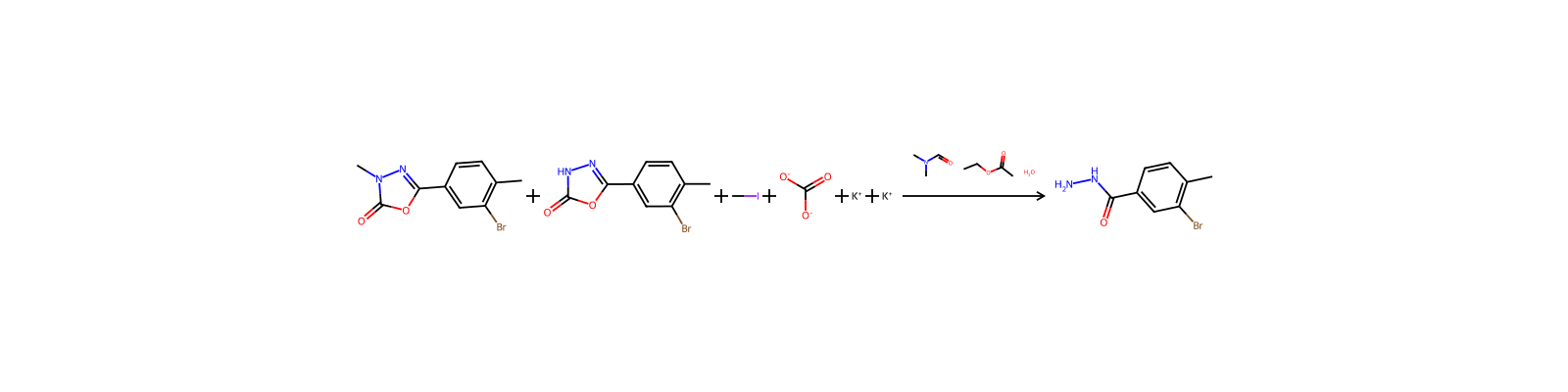
Step-3: 5-(3-Bromo-4-methylphenyl)-3-methyl-1,3,4-oxadiazol-2(3H)-one: A mixture of 5-(3-bromo-4-methylphenyl)-1,3,4-oxadiazol-2(3H)-one (400 mg, 1.57 mmol, 1.0 eq), methyl iodide (0.2 mL, 3.15 mmol, 2.0 eq) and potassium carbonate (210 mg, 3.15 mmol, 2.0 eq) in DMF (10 mL) was stirred at room temperature for 24 h. Water (50 mL) was added to the reaction mixture followed by ethyl acetate (30 mL). The layers were separated and the aqueous layer was extracted with ethyl acetate (2×20 mL). The combined organic layers were washed with water (2×25 mL), brine (20 mL), dried (Na2SO4) and filtered. The filtrate was concentrated under vacuum to afford 400 mg of the desired product as a white solid. 1HNMR (400 MHz, DMSO-d6) δ 7.90 (d, J=2.0 Hz, 1H), 7.70 (dd, J=8.0, 2.0 Hz, 1H), 7.54 (d, J=8.0 Hz, 1H), 3.40 (s, 3H), 2.41 (s, 3H); ESI-MS (m/z) 269, 271 [(MH)+, Br79,81].