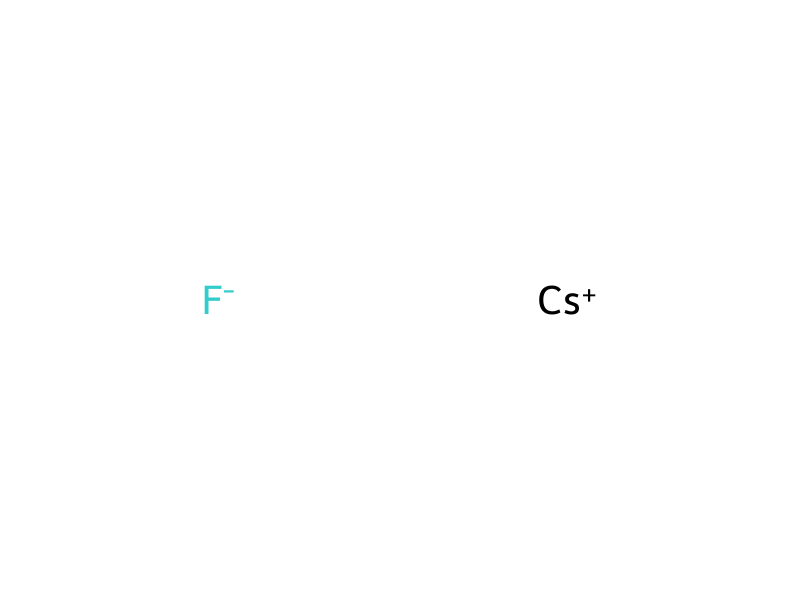
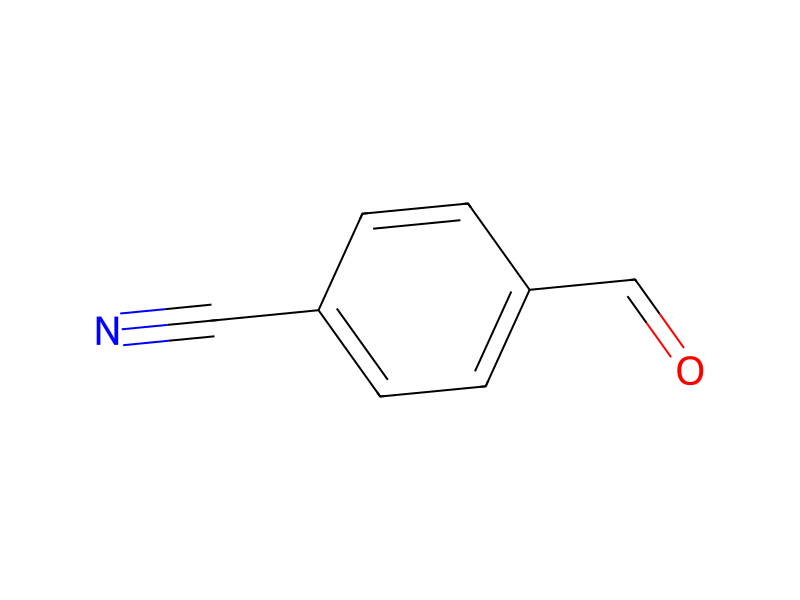
Cesium fluoride → p,p'-Dicyanobenzophenone
HRID 1768634
Reaktionsgleichung

[C:1]([C:3]1[CH:10]=[CH:9][C:6]([CH:7]=[O:8])=[CH:5][CH:4]=1)#[N:2].[F-].[Cs+].C[Si](C)(C)[C:15]1SC=[N:17][CH:16]=1>C1COCC1>[C:1]([C:3]1[CH:10]=[CH:9][C:6]([C:7]([C:3]2[CH:10]=[CH:9][C:15]([C:16]#[N:17])=[CH:5][CH:4]=2)=[O:8])=[CH:5][CH:4]=1)#[N:2]Komponenten
5
Edukt 3

Produkt 1

Reagenzien, Katalysatoren, Lösungsmittel 1

Versuchsvorschrift
15.7 g of 4-cyanobenzaldehyde and 9.1 g of caesium fluoride are added to a solution of 9.4 g of 5-trimethylsilylthiazole in 0.56 l of THF, and the mixture is heated under reflux for 16 hours. The solid material is filtered off and the solvent is concentrated. Column chromatography (SiO2, hexane/ethyl acetate 1:2) yields first (a) 5-(4-cyanobenzoyl)-thiazole [Rf hexane/ethyl acetate 1:2)=0.65], m.p. (after crystallisation from ethyl acetate) 181°-182°; 1H-NMR (CDCl3): δ (ppm)=8.88 and 8 (m,4H), 8.36 (s,1H), 9.14 (s,1H), and then (b)4-(α-hydroxy-5-thiazolylmethyl)-benzonitrile [Rf (hexane/ethyl acetate 1:2)=0.35], m.p. (after crystallisation from toluene) 115°-117°; 1H-NMR (CDCl3): δ (ppm)=3.05 (d,1H), 6.2 (d,1H), 7.58 and 7.7 (m,4H), 7.73 (s,1H), 8.78 (s,1H).